There was a time when Christmas in Reading, Pennsylvania meant something truly magical—a sensory experience that began the moment you stepped off the trolley onto the bustling sidewalks of Penn Street. In those golden decades from the 1920s through the 1960s, downtown Reading transformed into a winter wonderland that drew families from every corner of Berks County, creating memories that generations would carry with them for a lifetime.
The Heart of Holiday Shopping
Penn Street was the undisputed center of Christmas commerce in Berks County. Before the rise of suburban malls fundamentally altered retail patterns, this was the place to shop—largely because the multi-storied, long-established stores there had enormous inventories that simply couldn’t be matched anywhere else.
The shopping district stretched primarily along the 400, 500, and 600 blocks of Penn Street, anchored by the great department stores: Dives, Pomeroy & Stewart (later simply Pomeroy’s) at the southeast corner of 6th and Penn, and Whitner’s Department Store at 432-444 Penn Street. These retail giants were joined by an impressive array of specialty shops, five-and-dime stores, and smaller retailers that created a shopping ecosystem unrivaled in the region.
“Christmas shoppers congregated in such large numbers on Penn Street that one often had to walk out into the street to pass those who were walking too slowly,” recalled longtime residents. This remarkable scene repeated itself year after year, with hordes of shoppers flocking to center-city for their holiday purchases, filling the sidewalks to absolute capacity.
The Grand Department Stores
Pomeroy’s: The Crown Jewel of Penn Street
At the corner of 6th and Penn, Pomeroy’s stood as Reading’s largest and most elaborate department store. During the Christmas season, the store transformed into nothing short of spectacular.

Pomeroy’s decorated for the Christmas season
Pomeroy’s had the most elaborate street-level window displays in the city, which were a major attraction in themselves. Moving figures, some fashioned by puppeteers John and Jim Luft of Wernersville, would draw shoppers from all parts of Berks County. These weren’t simple displays—they were miniature theatrical productions featuring scenes of Santa’s workshop, winter villages dusted with artificial snow, and artfully arranged merchandise that promised the perfect gift for every member of the family.
But it was the sixth floor that held the most magic for children. After Thanksgiving, Pomeroy’s entire top floor was totally given over to holiday displays and the newest, neatest toys. Kids couldn’t wait to get inside to this toy department paradise.
One highlight of Toyland that many recall was the North Pole setting with its giant igloo that must have stood 15 to 20 feet high. It was a sight to remember—and it has been remembered by countless visitors who wandered around inside, their eyes wide with wonder.
Santa Claus himself held court in Pomeroy’s Toyland. As the Reading Newsweek reported during the war years: “Santa Claus is in his house in Pomeroy’s Toyland, and in other stores along Penn Street, and the sidewalks are filled with mothers and daddies who have just had Joe or Jane to see the old fellow, or are on their way. You can tell the kids who have already told Santa Claus what they want, because they are all clutching Donald Duck comic books which St. Nick gave them as token gifts.”
The store even featured unique Christmas traditions, including an American Indian who would sit on the main floor surrounded by children in a tight circle, with feathers and Indian goods for sale—a popular seasonal attraction. But as the Harrisburg Patriot-News noted in 1992, “if it is never remembered for anything else, Pomeroy’s will be remembered for its Christmas windows.”
Whitner’s: Reading’s Finest
Established by Calvin Kline Whitner, who began his retail career as a clerk in a general store in Oley Township, Whitner’s Department Store at 432-444 Penn Street was regarded as Reading’s finest department store during its heyday. Those old enough to remember shopping at Whitner’s and Pomeroy’s for holiday gifts might recall the lengths to which clerks went in those days to be helpful—they knew their stock intimately and showed it to its best advantage.

Whitner’s ready for Christmas, around 1950
The Five-and-Dime Wonderland
The 500 block of Penn Street was particularly notable for its concentration of five-and-dime stores, each one a treasure trove of affordable holiday gifts and decorations. Walking westward from 6th Street, shoppers could browse:
- S.S. Kresge Co. at 544 Penn Street
- F.W. Woolworth Co. (5 cents to $1.00 store) at 530 Penn Street
- McCrory’s (5 cents to $1.00 store) at 514 Penn Street
- W.T. Grant Co. at 504 Penn Street

South Side, 500 block of Penn Street
These stores had sales girls behind nearly every counter, ready to assist customers in finding the perfect small gift. As Barbara Wade wrote in her nostalgic poem about these beloved establishments:
“Kresge’s, Grant’s, Woolworth’s, McCrory’s, and Green’s,
All once were a part of Reading’s street scene…
But let us remember those happier days
Of busy lunch counters and bright paper bouquets;
Where kids could buy presents for only a dime,
Toilet water for Mom at holiday time.”
The warm ambience of the Five and Dime store was something special—friends meeting friends for coffee or more, the colorful displays, the accessible prices that made Christmas gift-giving possible for everyone.
The Community Christmas Tree
The centerpiece of Penn Street’s holiday decorations was the community Christmas tree, erected on Penn Square. During World War II, the Reading Newsweek reported: “The 20-foot community Christmas tree has gone up on a platform on the north side of Penn Street, between Fifth and Sixth.”
In keeping with wartime conservation measures, the tree during 1943 was “decorated with small American flags instead of lights. At night, it will be illuminated by two spotlights and the use of reflectors.” The previous year had seen dimout precautions eliminate the lighting, and in 1943, the restriction was to conserve electricity.
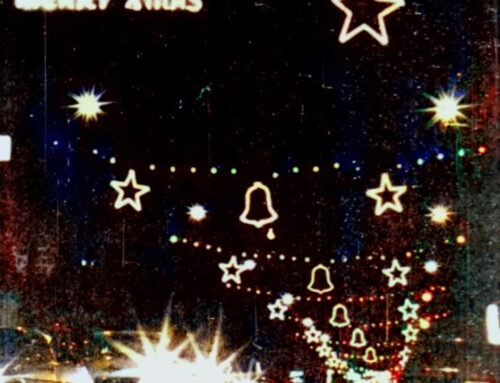
Christmas ornaments hung from the light standards of Penn Square, creating a magical nighttime atmosphere. A circa 1940 photograph captured this brilliance—with the United States Hotel visible on the left (not yet replaced by the A&P store), and the light streaks of automobile headlights moving through the slow time-exposure of the photograph creating an almost otherworldly glow.

Penn Street at Christmas 1940
The Holiday Spirit
What made Christmas on Penn Street truly special wasn’t just the shopping—it was the intangible spirit that pervaded everything. As the Reading Newsweek observed:
“So what gives with the approach of Christmas in Reading? Well, that holiday spirit is in the air, in addition to the signs that are visible. You know what we mean. People take on a sort of glow about this time of year, and in spite of the shopping crowds, and packed busses and trolleys, and other rushing about, there’s a patience and tolerance and kindliness that the biggest grouch in the world couldn’t conceal, no matter how hard he tried.”
The streets came alive with more than just shoppers. Go-getters stationed themselves at strategic points selling newspapers, flowers, popcorn and peanuts, ice cream products, and novelties like kazoos, yo-yo’s, and balloons. Roving photographers would take your picture and give you a numbered envelope to send in your dollar for the print.
Among the most beloved vendors was the old man who sold hot chestnuts in winter on the north side of Penn Street, and the fellows who sold soft pretzels at the southeast corner of 5th and Penn—including Harry S. Kline, who was permitted to sell soft pretzels from his small electric-powered cart in front of Grant’s 5&10 after losing his right leg while working as a butcher in Bernville.
Thursday Evenings: A Shopping Tradition
Penn Street stores observed a special tradition: they were kept open late on Thursday evenings for the convenience of working families. This extended shopping hour became a cherished weekly ritual during the Christmas season, allowing those who worked during regular hours to participate in the holiday shopping experience.
Store Windows: Theatrical Productions
“Windows of Penn Street stores have already taken on their Christmasy look,” the Reading Newsweek reported during the war years, “influenced no doubt by the urgency of early mailing of gift packages to G.I.’s overseas. It was just as though it was all done on a signal. Overnight stores along the Main Stem all took the Santa Claus look.”
Store owners competed not just for customers, but for the admiration of passersby. Display windows became miniature theatrical productions—scenes of Santa’s workshop, winter villages dusted with artificial snow, and artfully arranged merchandise that promised the perfect gift for every member of the family.
The Decorating Companies
The elaborate decorations that transformed Penn Street weren’t achieved without considerable effort and expense. It boggles the mind to contemplate the effort and expense that went into decorating the city’s largest department stores and hotels to the degree seen in historical photographs.
Most of the decorations were obtained from a single source: the Hipple Brothers (Douglass and Webster), later trading as Hipple Decorating Co. The Mishler Decorating Co. at 522 Court Street also had a share of the business, regularly supplying bunting and decorations.
A Child’s Christmas Memory
Perhaps no one captured the magic of a Penn Street Christmas better than Barbara Wade in her poem about Pomeroy’s:
“We would stumble forth from the dark
of the theater’s warm cocoon
into the blinding light and cold
of a winter’s afternoon,
my sister, my brother, and I,
running for 6th and Penn,
through frosty doors and elevator men
to a 6th floor full of toys
in a store they called Pomeroy’s.
But, oh, what scents,
and, oh, what sights,
what sacred toyland sounds…”
The Decline
The golden age of Penn Street Christmas shopping reached its peak in the decades following World War II. But change was coming. The growing number of suburban shopping centers, combined with urban renewal projects, began to alter both traffic and shopping patterns for the city.
“It’s sad to note that the Christmas before Pomeroy’s closed, in 1985, the sidewalks outside the store were all but devoid of shoppers,” observed one historical account. The contrast with the bustling crowds of earlier decades was stark and melancholy.
Whitner’s closed in June 1981, and after sitting vacant for many years, the building was demolished in 2004 and replaced by the Sovereign Plaza.
A Legacy Remembered
Though the great department stores are gone and the five-and-dimes have been “crumbled to ashes by the grim wrecker’s ball, condemned to rebirth at a place called the mall,” the memories of Christmas on Penn Street endure.
Those who experienced the magic of Pomeroy’s sixth floor Toyland, who pressed their noses against elaborate window displays, who walked through crowds so thick they had to step into the street, who smelled the roasting chestnuts and heard the Christmas carols—they carry with them a piece of Reading’s history that no suburban shopping center could ever replicate.
The Christmas spirit that once transformed Penn Street into a wonderland of lights, decorations, and holiday cheer represents more than just retail nostalgia. It was a communal experience that brought together families from across Berks County, creating shared memories and traditions that bound the community together.
As we look back on these golden years, we remember not just the stores and the merchandise, but the feeling—that magical, indefinable holiday spirit that made Christmas on Penn Street an experience unlike any other.


Leave A Comment