
Long before Christmas lights became a seasonal expectation in Reading, North Ninth Street merchants made illumination a statement of survival, pride, and identity. The glow that once stretched from Penn Street northward was not decorative excess—it was the visible result of decades of cooperation by business owners who understood that Ninth Street was more than a shopping strip. It was one of Reading’s oldest roads, a historic artery, and a neighborhood lifeline.
A Road Older Than the City It Served
North Ninth Street predates Reading itself. More than 200 years old by the time electric lights first appeared overhead, it began as a primitive north–south route linking farms, mills, and settlements between the Schuylkill Valley and the Lehigh region. Long before automobiles, wagons bound for Allentown rumbled over Ninth Street, carrying goods, livestock, and people. Revolutionary War soldiers marched along it. During the Civil War, military traffic used it heavily. For much of its early life, Ninth Street was not a “city street” at all, but a working road—muddy in winter, dusty in summer, and barely passable in bad weather.
It was not until the late 19th and early 20th centuries that Ninth Street began to transform. Stone paving, later replaced by macadam, improved travel. The arrival of trolley lines in the 1870s and 1880s fundamentally changed the street’s role, turning it into a commercial spine connecting neighborhoods north of Penn Street to downtown. With transit came foot traffic, and with foot traffic came stores.
The Rise of a Neighborhood Business Street
By the early 1900s, Ninth Street had become a true neighborhood business district—distinct from Penn Street’s department-store grandeur, but no less vital. Small, family-run establishments clustered between Penn, Walnut, Washington, Buttonwood, and Elm Streets. Drugstores, jewelers, milliners, florists, dry goods shops, restaurants, and professional offices lined the blocks. St. Paul’s Church at Ninth and Walnut anchored the street spiritually and socially, drawing steady daily activity.
This was a street where merchants knew their customers by name. Many shop owners lived nearby. Their livelihoods were tied directly to the safety, appearance, and accessibility of the street itself.
Christmas Lights as a Turning Point
In the 1920s, Ninth Street merchants began experimenting with Christmas lighting strung from poles during the holiday season. The effect was immediate. The street felt safer. Foot traffic increased. Shoppers lingered. What began as a seasonal embellishment sparked a realization: light could change the destiny of a street.
At the time, Ninth Street was poorly lit. Outside the Christmas season, just eight small bulbs illuminated three long blocks from Penn to Elm, leaving deep shadows cast by trees and poles. Pedestrians avoided the street at night. Business suffered after dark.
Rather than wait for the city, the merchants organized.
The North Ninth Street Merchants’ Association Takes Shape
Out of informal conversations and shared concerns emerged the North Ninth Street Merchants’ Association, formally incorporated in 1927. Meeting initially in the Kotzen Building at 35A North Ninth Street, the group elected E. Louis Kotzen as president, a role he would hold through the association’s formative years. From a small circle of shopkeepers, the organization grew rapidly, eventually encompassing nearly 200 merchants whose livelihoods depended on the health and accessibility of Ninth Street.
Their mission was clear: protect Ninth Street’s economic future.
One of the association’s very first battles had nothing to do with decorations or promotions, but with traffic—and survival. During Mayor Sharman’s administration, city officials proposed eliminating the left-hand traffic turn at Ninth and Penn Streets, a move merchants immediately recognized as an existential threat. Reduced access meant fewer shoppers, disrupted delivery routes, and a steady erosion of foot traffic that many small businesses could not afford.
What followed was described at the time as an “emotional battle,” but beneath the passion was a torrent of logical, practical arguments. The merchants banded together, standing firm and obstinate in their objections, pleading their case with clarity and conviction. Their reasoning was simple: the daily “bread and butter” of Ninth Street depended on two-way access. In this instance, the association prevailed. North Ninth Street remained a two-way street—for a time—marking an early and important victory that proved collective action could influence City Hall.
The struggle, however, did not end there. Under the following city administration, Reading again moved to reconfigure traffic in the name of efficiency, proposing to make North Ninth Street a one-way thoroughfare. This time, despite a valiant and carefully conducted effort to prevent the change, the merchants were unable to stop it. The decision dealt a significant blow to businesses along the corridor, yet the association continued to advocate, adapt, and press forward despite the setback.
To an outside observer, such disputes might have seemed minor—mere adjustments in traffic flow. To the merchants of North Ninth Street, they were matters of survival. Access, visibility, and movement were inseparable from commerce, and the association’s early years were defined by this hard lesson: progress, without consideration for local business, came at a cost.
But their most ambitious effort was still ahead.
Building Reading’s First Merchant-Funded “White Way”
By 1930, the association set its sights on permanent street lighting. When told the city could not afford a major upgrade, the merchants proposed a solution themselves. Property owners were assessed one dollar per foot of frontage, raising $2,600, which was placed with Metropolitan Edison to cover the added power costs. In return, the city installed 34 boulevard lights, each rated at 400 candlepower, mounted on iron standards that replaced wooden poles. Nearly all trees along the corridor were removed to maximize illumination.
On December 1, 1930, Mayor Stump threw the switch, officially inaugurating North Ninth Street’s White Way—one of the best-lit thoroughfares in Reading. A parade followed. Hundreds gathered near St. Paul’s Church. Civic leaders praised the merchants’ initiative. Ninth Street quite literally stepped into the spotlight.
Kotzen did not mince words. Proper lighting, he argued, increased business, reduced crime, improved traffic safety, and attracted crowds. At the time, annual business along those blocks exceeded $2 million, and merchants believed the investment would double that figure.
Below: A view of Reading’s new “White Way” on North Ninth Street, looking south from Washington Street, showcasing the newly installed boulevard lamps. The photo highlights one of the 34 lights, each rated at 400 candlepower.

Christmas Becomes a Street-Wide Event
From that point forward, Christmas was inseparable from Ninth Street’s identity. Each year, the Merchants’ Association coordinated decorations, parades, and celebrations. Colored lights stretched from Penn to Buttonwood. Laurel garlands adorned poles. Trees rose at Ninth and Walnut. Santa arrived by car, scooter, or float. Bands, choruses, drum and bugle corps, and neighborhood groups filled the street. Candy was handed out to children. Thousands packed the sidewalks.
These were not city-run events. They were merchant-funded, merchant-organized, and merchant-led, designed to draw people not just to stores, but to the street itself.
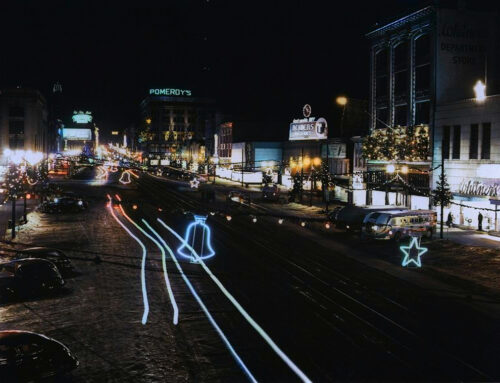
Even during wartime restrictions, when lighting was curtailed, the spirit remained. When the association fell dormant for a time, it was revived in 1948, once again rallying around Christmas. That year, merchants invested nearly $2,500 in neon star displays, mounting forty-inch stars on light poles and six-foot stars at block entrances. Parades returned. Crowds followed.
Holding On as the City Changed
By the 1950s and 1960s, Ninth Street faced new challenges. One-way traffic conversions, suburban shopping centers, and urban renewal projects altered shopping patterns across Reading. Yet the North Ninth Street Merchants’ Association persisted, continuing to sponsor Christmas lighting and events into the late twentieth century. As late as the 1980s, the group was still refurbishing and reinstalling lights—an echo of the same strategy first used generations earlier: use light to signal life.
Below: Christmas on Ninth, 1952 — On Thanksgiving Eve, holiday lights were switched on along North Ninth Street between Penn and Elm Streets, bathing the corridor in a Christmas glow. This festive scene, photographed at the Penn Street intersection looking north, marked the season’s start and was sponsored by the Ninth Street Merchants’ Association.

A Legacy That Still Glows
Today, the lights are gone. Many of the storefronts are gone. The crowds have moved elsewhere. But the story of Ninth Street remains one of Reading’s most instructive chapters.
The North Ninth Street Merchants’ Association understood something fundamental: streets thrive when people feel welcome, safe, and connected. Their Christmas lights were never just seasonal decoration. They were acts of civic faith—proof that local merchants, working together, could shape their environment and define their future.
For decades, when winter settled over Reading, Ninth Street answered with light.
And for a time, it worked.


Leave A Comment