In the early decades of the twentieth century, Reading was a city in motion—industrial, crowded, and increasingly conscious of how its streets functioned not only as conduits for traffic, but as shared public spaces. Long before modern redevelopment plans or branding campaigns, Reading’s neighborhoods and commercial corridors were already shaping the city’s identity through collective action. Few examples illustrate this better than the transformation of North Ninth Street, whose evolution from a dim, shadowed roadway into one of the city’s brightest thoroughfares reflected a broader civic push toward safety, prosperity, and civic pride.
At the time, North Ninth Street was far more than a local shopping strip. It was one of Berks County’s oldest highways—over 200 years old by 1930—and had long served as a primary route between Reading and the Lehigh Valley. Revolutionary War troops, Civil War supply wagons, early settlers, and later trolley cars all moved along this corridor. Yet despite its importance, the street remained poorly lit well into the twentieth century. Outside of the Christmas season, just eight small lights illuminated three busy blocks between Penn and Elm Streets, leaving pedestrians navigating pools of darkness and merchants watching evening traffic thin out after sundown.
What changed was not a sudden municipal initiative, but a growing recognition across the city that lighting mattered. As Reading expanded and modernized, well-lit streets increasingly came to be seen as safer streets—places that attracted shoppers, discouraged crime, and fostered nighttime activity. Across the city, new boulevard lighting was appearing in neighborhoods like Millmont and other developing areas. North Ninth Street’s merchants, observing both seasonal Christmas lighting success and improvements elsewhere in Reading, pushed for permanent illumination that would serve not just their businesses, but the public at large.
The result was one of Reading’s earliest and most visible “white ways.” In 1930, after merchants raised $2,600 to offset additional power costs, the city installed 34 boulevard lights, each rated at 400 candlepower. Ugly wooden poles were replaced with iron standards, trees were trimmed or removed to eliminate shadows, and the street was transformed. When Mayor Stump threw the switch and the lights came alive, it was celebrated not merely as a merchant victory, but as a civic milestone—complete with a parade, speeches, and public praise for the cooperative spirit behind the effort.
Below: A view of Reading’s new “White Way” on North Ninth Street, looking south from Washington Street, showcasing the newly installed boulevard lamps. The photo highlights one of the 34 lights, each rated at 400 candlepower.

City leaders understood the broader implications. Councilman George Snyder and Chamber of Commerce officials openly framed the Ninth Street project as a model for Reading’s future, arguing that improved lighting could beautify neighborhoods citywide without dramatically increasing municipal costs. The success of Ninth Street demonstrated how public-private cooperation could enhance safety, stimulate commerce, and elevate the everyday experience of city life. In an era when Reading was competing with other industrial cities for growth and investment, such improvements mattered.
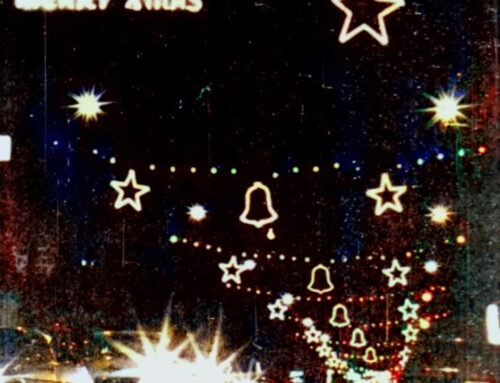
Holiday lighting soon became another expression of this shared civic spirit. Long before Penn Street’s grand department stores dominated Christmas imagery, Ninth Street’s merchants were organizing parades, stringing red and green lights, installing stars and greenery, erecting community Christmas trees, and welcoming Santa Claus with crowds numbering in the thousands. These celebrations spilled beyond Ninth Street itself, drawing families from across Reading and reinforcing downtown as the city’s seasonal gathering place.

Christmas on Ninth Street, 1952
Over time, these traditions became woven into Reading’s identity. They reflected a period when neighborhoods mattered, when commercial streets doubled as social spaces, and when improvements were measured not only in dollars, but in how they made people feel walking home at night or shopping with their children. Even as suburban shopping centers and urban renewal projects later reshaped traffic patterns and diminished downtown retail, the memory of those illuminated streets endured.
Today, when Reading debates revitalization, lighting, walkability, and placemaking, the story of Ninth Street offers a reminder: the city has faced these questions before—and answered them through cooperation, vision, and community pride. The glow that once stretched from Penn to Elm was more than electricity on wire. It was a signal that Reading believed in itself, block by block, street by street, lighting the way forward together.


Leave A Comment