Editor’s Note: GoReadingBerks does not endorse any political party, candidate, or economic ideology. This article examines the renewed national debate over the American System because of its historical relevance to Reading and Berks County. Our goal is to distinguish documented historical facts from competing interpretations and present the principal arguments fairly, allowing readers to draw their own conclusions.
A major shift is taking place in how American political leaders talk about the economy. President Donald Trump and members of his administration have increasingly invoked ideas associated with the American System—a tradition that emphasizes domestic manufacturing, protective trade policies, national infrastructure, and economic independence.
Vice President J.D. Vance has described the emerging economic outlook of the American right as more closely aligned with Alexander Hamilton than with Milton Friedman. In doing so, he has framed Hamiltonian economics not as a historical curiosity, but as a possible foundation for the future of American conservatism.
That argument has divided the political right. Some traditional free-market conservatives continue to defend Friedman’s emphasis on limited government, lower trade barriers, and market competition. Others argue that Hamilton himself supported private enterprise and should not be confused with socialism simply because he believed government had an important role in building national industry.
On the political left, critics have also questioned the administration’s use of tariffs, subsidies, emergency powers, and industrial policy. Some portray those measures as excessive government intervention, while supporters argue they are necessary to rebuild industries weakened by decades of globalization.
This national debate may sound abstract, but it has direct relevance to Reading and Berks County. Rather than advocating for one side, this article explores how competing economic philosophies intersect with the region’s history. It asks a straightforward question: To what extent was Reading’s industrial rise connected to Hamiltonian-style economic policies, and to what extent was its later decline shaped by the changing economic policies that followed?
There is no single, universally accepted answer. Reading’s history reflects the influence of national policy, geography, entrepreneurship, technological innovation, immigration, transportation, and countless local decisions. The renewed debate over the American System simply offers one framework through which historians, economists, policymakers, and citizens are once again examining America’s industrial past—and its future.
Reading and the Rise of American Industry
Alexander Hamilton’s economic vision emphasized the development of a strong and independent national economy. Although the phrase “American System” became more closely associated with Henry Clay in the nineteenth century, its central ideas reflected Hamilton’s earlier arguments.
Those ideas generally included:
- Protective tariffs intended to support American manufacturers.
- National investment in roads, canals, railroads, and other infrastructure.
- A strong financial system capable of supporting commerce and industrial growth.
- Government policies designed to reduce dependence on foreign production.
Throughout much of the nineteenth and early twentieth centuries, the United States adopted policies that reflected at least some of these principles. During that same period, Reading and Berks County became major centers of transportation, manufacturing, textiles, metal production, and skilled labor.
The Reading Railroad, incorporated in 1833, became one of the nation’s most important transportation systems. It carried Pennsylvania anthracite coal to homes, factories, cities, and ports throughout the region.
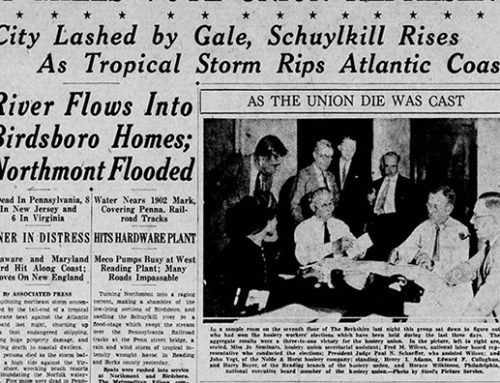
In Wyomissing, Ferdinand Thun and Henry Janssen established an industrial network that included Berkshire Knitting Mills, which became one of the world’s largest full-fashioned hosiery manufacturers.
Carpenter Steel, founded in 1889, became another major industrial force. The region also supported foundries, machine shops, textile mills, railroad facilities, metalworking companies, and countless smaller businesses connected to the industrial economy.
These are matters of historical record. The more interpretive question is why Reading became so successful.
Supporters of Hamiltonian economics argue that Reading flourished in part because the United States protected and encouraged domestic industry. Tariffs helped shield manufacturers from some forms of foreign competition, while railroads and other infrastructure connected local producers to a growing national market.
Other historians and economists emphasize additional factors. Reading benefited from its geographic location, access to coal and transportation, immigration, entrepreneurial leadership, technological innovation, population growth, wartime demand, and the broader expansion of the American economy.
For that reason, it would be too simple to describe Reading as the product of one economic policy. Still, its industrial rise occurred within a national system that placed far greater emphasis on domestic production than the United States would later adopt.
The American System and the Question of National Independence
Some modern advocates of Hamiltonian economics describe the current debate as part of a much older struggle between the American System and what they call the British System.
Historically, Britain sought to organize its empire so that colonies supplied raw materials and purchased finished British goods. The American colonies were often discouraged or restricted from developing industries that competed directly with British manufacturers.
Hamilton’s economic program represented a rejection of that dependent relationship. He believed the United States needed its own manufacturing base, financial institutions, infrastructure, and technological capabilities if it was to remain politically independent and economically secure.
Later American leaders, including Henry Clay, Abraham Lincoln, and William McKinley, supported policies that continued parts of this tradition. They promoted tariffs, internal improvements, railroads, manufacturing, and national development.
Supporters of the American System argue that these policies helped transform the United States from a largely agricultural country into the world’s leading industrial power.
Some go further, describing modern globalization and free trade as a revival of the old British model: a system in which financial interests and cheap imports take precedence over national production.
That comparison is controversial and should be understood as an interpretation rather than an uncontested historical conclusion. Modern global trade is not identical to the British Empire’s colonial system. Countries today participate in complex supply chains, international investment, and reciprocal trade relationships that did not exist in the eighteenth century.
Critics of the “British System” comparison argue that it oversimplifies both history and the modern global economy. They point out that trade can lower prices, expand consumer choice, encourage specialization, spread technology, and open foreign markets to American companies.
Supporters respond that those benefits can come at a serious cost when a country loses the ability to manufacture essential goods. In their view, economic independence requires more than access to inexpensive imports. It requires the domestic capacity to produce the equipment, materials, technology, energy systems, and defense products necessary for national survival.
This is the central philosophical disagreement. One side places greater trust in global markets and international specialization. The other believes markets must operate within a national strategy designed to preserve industrial strength and political sovereignty.
The Transition Toward Globalization
By the second half of the twentieth century, American economic policy increasingly moved toward lower tariffs, fewer trade barriers, deregulation, and globally integrated production.
Economists influenced by Milton Friedman and other free-market thinkers argued that goods should be produced wherever they could be made most efficiently. Consumers would benefit from lower prices, businesses would gain access to global markets, and national economies would become more productive through specialization.
Both major political parties participated in this shift. Trade liberalization, financial deregulation, technological advances, containerized shipping, corporate restructuring, and the growth of multinational supply chains all changed where and how goods were produced.
Reading and Berks County experienced major economic disruption during this period.
Local textile and apparel manufacturers faced increasing competition from regions and countries with much lower labor costs. Some companies closed, relocated, reduced employment, automated production, or shifted work abroad.
The Reading Railroad also faced pressures that were not caused by trade policy alone. The decline of anthracite coal, competition from trucking, changes in passenger transportation, corporate financial problems, and broader restructuring within the railroad industry all contributed to its bankruptcy in 1971.
Other local industries were affected by automation, changing consumer demand, suburbanization, technological change, aging industrial facilities, corporate decisions, and the movement of population and investment away from older cities.
As a result, it would be inaccurate to attribute Reading’s decline entirely to Milton Friedman, free trade, or any single policy.
At the same time, supporters of the Hamiltonian interpretation argue that trade liberalization accelerated deindustrialization and made recovery more difficult. They contend that American workers were forced to compete with foreign labor operating under very different wage, regulatory, and environmental conditions.
Critics of a renewed American System argue that tariffs can increase costs for consumers, invite retaliation from trading partners, and reduce economic efficiency. They contend that Reading’s decline resulted from technological change, automation, transportation shifts, corporate restructuring, and broader changes in the global economy that no single trade policy could have prevented.
Supporters respond that while those forces were real, government policy accelerated deindustrialization by failing to preserve critical domestic industries. In their view, policymakers treated factory closures as an acceptable cost of economic efficiency without adequately considering the long-term effect on communities, workers, supply chains, and national security.
The most reasonable conclusion may be that globalization was neither the sole cause of Reading’s decline nor an irrelevant factor. It interacted with many other economic and technological changes, often placing additional pressure on industries that were already vulnerable.
The Human Cost of Industrial Decline
The decline of manufacturing was not simply a change in economic statistics. It transformed the social and physical landscape of Reading.
Factories that had once provided stable employment closed or reduced their workforces. Skilled industrial jobs became less available. Vacant buildings and underused industrial sites appeared across the city. The tax base weakened, while the demand for public services remained high.
Many middle-class families and businesses moved to surrounding municipalities. This widened the economic divide between Reading and some of its neighboring communities.
The resulting poverty cannot be explained only by the loss of manufacturing. Housing patterns, education, municipal boundaries, immigration, regional inequality, crime, public policy, and demographic change also played important roles.
Nevertheless, the disappearance of large-scale industrial employment removed one of the city’s primary pathways into the middle class.
For supporters of the American System, Reading demonstrates what can happen when national policy prioritizes low consumer prices and global efficiency without giving equal attention to local production and community stability.
Critics caution against romanticizing the industrial past. Factory work could be dangerous, polluted the environment, involved harsh working conditions, and was often vulnerable to economic cycles. They also note that many traditional manufacturing jobs would have been affected by automation even if trade policies had remained more restrictive.
Both points can be true. Industrial Reading was neither an economic paradise nor an insignificant achievement. It created prosperity and opportunity, while also producing social and environmental costs. Its decline resulted from multiple forces, but the loss of industry had lasting consequences that cannot be dismissed.
National Security and the Limits of the Market
The modern Hamiltonian argument is increasingly focused on national security rather than only employment.
The COVID-19 pandemic, global shipping disruptions, military tensions, energy concerns, and shortages of critical components revealed how dependent the United States had become on foreign supply chains.
Recent federal actions involving energy infrastructure illustrate this concern. In invoking the Defense Production Act and other emergency authorities, the Trump administration argued that inadequate domestic energy production and manufacturing capacity posed a threat to national prosperity and national defense.
The administration specifically highlighted the limited American capacity to produce large power transformers and other essential grid equipment. These components can require long lead times, and the United States relies heavily on imported equipment and materials.
Supporters of industrial policy see this as evidence that market incentives alone do not always provide the productive capacity a nation needs during war, disaster, or economic disruption.
Private companies generally make decisions based on cost, risk, demand, and profitability. Those decisions may be rational for individual firms while still leaving the country vulnerable as a whole.
A company may find it cheaper to import transformers, medicines, semiconductors, steel, or other critical goods. But if many companies make the same decision, the nation can lose the domestic knowledge, workforce, factories, and equipment needed to produce those goods during an emergency.
American System advocates therefore argue that government has a legitimate role in preserving strategically important industries. They support tools such as tariffs, procurement requirements, public financing, infrastructure investment, tax incentives, and emergency production authorities.
Critics warn that these policies can be abused. Government support may protect inefficient companies, reward politically connected industries, increase prices, or direct money toward projects that fail to create lasting economic value.
They generally favor narrower interventions focused specifically on defense and critical infrastructure rather than a broad return to protectionism.
The disagreement is not simply between capitalism and socialism. It is a disagreement over whether markets, operating largely on their own, will maintain the productive capabilities required for national resilience.
Breaking Out of the False Binary
Much of the modern debate is distorted by a false choice between unrestricted free markets and government-controlled socialism.
Hamilton did not advocate the abolition of private enterprise. He believed private investment, entrepreneurship, commerce, and manufacturing were essential to national development.
However, he did not believe government should remain passive. He argued that public policy could encourage industries that were strategically important but not yet strong enough to compete with established foreign producers.
Modern Hamiltonian advocates make a similar argument. They do not necessarily seek government ownership of factories. Instead, they want government to shape the economic environment in which private firms operate.
That can include tariffs, infrastructure spending, domestic-content requirements, industrial financing, workforce development, research support, and policies that reduce dependence on foreign competitors.
Free-market critics argue that government officials are often poorly equipped to determine which industries deserve protection. They warn that intervention can distort investment, preserve outdated businesses, and create opportunities for lobbying and corruption.
Hamiltonian supporters respond that refusing to make strategic choices is itself a policy choice. Allowing essential industries to disappear because foreign production is temporarily cheaper can create larger costs later.
The real debate, then, is not whether markets should exist. It is whether markets should be treated as an end in themselves or as tools that must operate within broader national goals.
From Economic Philosophy to Local Recovery
The debate over the American System matters to Reading not only because it offers one interpretation of the city’s industrial past, but because it raises practical questions about its future.
Reading is not a city without assets. It is a city whose assets have become disconnected from one another. The region still benefits from major transportation corridors, an established manufacturing base, educational institutions, redevelopment opportunities, and a skilled workforce. Yet many city residents remain disconnected from those advantages by transportation barriers, educational gaps, housing instability, limited access to capital, and mismatches between available jobs and available skills.
Reading’s decline should therefore not be understood solely as a local failure. Local decisions mattered, but so did broader structural changes. Manufacturing moved away from many older industrial cities. Rail-centered communities were reshaped by highways and suburban development. Corporate ownership became increasingly distant from the communities where production occurred. Automation reduced employment even where factories remained, while national trade, tax, transportation, and monetary policies influenced where businesses invested and expanded.
Supporters of the American System argue that recovery requires reconnecting the elements that once reinforced one another: productive industry, infrastructure, skilled labor, local investment, and long-term economic development. Critics respond that national industrial policy alone cannot overcome challenges such as education, public safety, housing, municipal finances, or technological change. Both perspectives ultimately suggest that meaningful recovery would require cooperation among federal, state, county, and local institutions.
A modern American System would not attempt to recreate the Reading of 1900 or 1950. Modern manufacturing is more automated, technologically advanced, and globally integrated than the industries that once dominated the city. Instead, supporters envision building competitive industries in areas such as advanced manufacturing, specialty metals, transportation equipment, energy technology, medical devices, defense suppliers, food processing, and industrial maintenance.
Achieving that vision would require stronger partnerships among Reading School District, Reading Area Community College, Berks Career and Technology Center, local unions, and regional employers. Public incentives could be tied to measurable outcomes such as family-supporting wages, apprenticeships, local hiring, environmental cleanup, capital investment, and long-term employment rather than short-term development alone.
Just as important is the question of ownership. A city can experience new construction, rising property values, and ribbon-cutting ceremonies while its residents remain economically stagnant if buildings are owned by distant investors, profits leave the region, and local families are unable to build wealth through homeownership or business ownership.
Berks County continues to possess important competitive advantages, including its strategic location, industrial heritage, existing manufacturers, transportation network, and proximity to major East Coast markets. Yet tariffs or federal investment alone would not guarantee Reading’s recovery. Local leadership, workforce preparation, infrastructure, entrepreneurship, housing, public safety, and effective regional cooperation will remain essential.
Critics also caution that industrial policies carry risks. Tariffs may increase costs for manufacturers that rely on imported materials, invite retaliation from trading partners, or protect industries that are no longer competitive. Supporters respond that those risks should be weighed against the long-term costs of industrial decline, vulnerable supply chains, and dependence on foreign production for strategically important goods.
Ultimately, Reading’s recovery should not be measured only by factories opened, apartments constructed, or development dollars announced. It should be measured by whether residents gain useful skills, family-supporting employment, opportunities for homeownership and entrepreneurship, and the ability to build lasting wealth.
The greatest danger is not that Reading will experience no development. The greater danger is that it will experience development without recovery—appearing more prosperous through new buildings and investment while many of its existing residents remain disconnected from the benefits. A successful recovery should improve not only the city’s skyline, but also the lives and economic opportunities of the people who call Reading home.
A Debate That Reading Cannot Ignore
The renewed debate over Hamilton, Friedman, tariffs, free trade, and industrial policy is not simply an argument among politicians and economists.
It concerns the kind of economy the United States wants to maintain.
Should national policy focus primarily on low prices, market efficiency, and global competition? Or should it also actively preserve domestic industry, skilled employment, supply-chain resilience, and economic independence?
Reading’s history does not provide a simple answer.
The city’s rise resulted from a combination of national policy, private enterprise, natural resources, technology, labor, transportation, and local leadership.
Its decline also resulted from multiple causes, including automation, changing transportation patterns, the decline of coal, corporate decisions, suburbanization, demographic change, and globalization.
Still, the Hamiltonian interpretation raises a question that cannot be easily dismissed: What happens to a community—and ultimately to a nation—when productive capacity is treated as interchangeable and allowed to disappear wherever short-term costs are lower?
Supporters of the American System believe the United States is beginning to answer that question by rebuilding domestic production and treating industrial capacity as a matter of national security.
Critics fear that the same policies could increase prices, provoke trade conflicts, protect inefficient industries, and give government too much power over economic decisions.
Whether the current shift succeeds remains uncertain.
What is clear is that Reading and Berks County have already lived through both the achievements of American industrial growth and the consequences of industrial decline. That makes the region more than a historical example. It makes Reading a valuable case study in the continuing battle over America’s economic soul.




Leave A Comment