
Silk Stockings.
Soldiers.
Students.
The astonishing century-long transformation of 12th and Bern Streets—from Noe-Equl Hosiery Mills to Princess Royal, Bowers Battery, the Army Reserve, and finally Albright College.
At first glance, the corner of 12th and Bern Streets looks like just another piece of the modern Albright College landscape. But beneath that quiet surface is one of the most dramatic industrial stories in Reading—a place where silk hosiery, battery production, military training and college expansion all occupied the same ground.
Reading’s forgotten hosiery giant
Noe-Equl Hosiery Mills, Inc. was incorporated in Pennsylvania in 1922 by Edward Glasser, David E. Pursell and Stanley H. Pursell. Its purpose was the manufacture and sale of hosiery, underwear and other knitted goods.
By 1923 the company was publicly identifying its factory at 12th and Bern Streets. The operation expanded quickly. In 1924, Noe-Equl announced another three-story brick factory beside its existing mill. Contemporary reports said roughly 300 people were already employed and that the expansion could create another 350 to 400 jobs.
For a company now nearly forgotten, the scale was startling. At its most ambitious, Noe-Equl was positioning itself as a major Reading textile employer.

“From the maker direct to you”
Noe-Equl did more than manufacture stockings. It built a national direct-sales organization. Representatives carried samples and catalogs into customers’ homes, collected deposits, and sent orders back through the company’s network to Reading.
Its 1920s advertising promoted silk hosiery and lingerie sold directly from the manufacturer, bypassing some of the expense of conventional retail distribution.
The company sold stockings, slips, chemises, nightgowns, bloomers and other women’s garments. Reading-made goods were being marketed far beyond Pennsylvania.

One site. Five identities. Nearly a century of Reading history layered on the same ground.
Noe-Equl → Princess Royal → Bowers Battery → Army Reserve → Albright CollegeNoe-Equl began in 1922 with substantial capitalization for a local manufacturer.
The company leased the Pursell-owned factory with an option to purchase.
Approximate workforce during the mid-1930s before the final shutdown.
Approximate floor area in use by Bowers Battery in 1948.
Noe-Equl becomes Princess Royal
In 1924, the original company broadened its name to Noe-Equl Textile Mills, Inc. In 1926, assets were transferred into a Delaware corporation carrying the same name.
Then came the key change: in May 1928, the Delaware corporation formally changed its name to Princess Royal Hosiery Mills, Inc.
This was not simply a new tenant moving into the old factory. Princess Royal was the renamed corporate successor to Noe-Equl.
A confusing second Noe-Equl
Later in 1928, the separate Valley Throwing Company adopted the Noe-Equl Textile Mills name. That created two different corporate histories and explains why later records can appear contradictory.
The strike, the shutdown and the auction
The summer of 1928 brought a bitter labor dispute involving full-fashioned knitters and the controversial two-machine system. The conflict became entangled in Reading’s broader political and labor struggles.
Princess Royal continued production into the 1930s, employing roughly 240 to 250 people when operating. But by late 1937 the company was in trouble. The plant closed in December.
On March 23, 1938, the factory’s machinery was auctioned. The sale included 57 full-fashioned hosiery knitting machines, 41 topping tables, dyeing equipment, boarding and finishing machinery, office furniture and other plant equipment. Contemporary reporting said the company would be dissolved.
From silk stockings to batteries
In 1943, the former Princess Royal plant was leased to Bowers Battery and Spark Plug Company. Approximately 50,000 square feet were adapted for industrial battery production, spark-plug work and related manufacturing.
By 1948, about 100 men were working there, and contemporary reports described roughly 47,000 square feet of floor space in use.
Then another transformation began. The Second Army started considering the property for Organized Reserve Corps use.
The Army Reserve era
By 1949, the former factory had become an Organized Ground Force Reserve Armory. Its manufacturing floors were divided into classrooms, administrative offices, supply rooms, instructor spaces, storage areas and a drill hall.
Approximately 20 Reserve units were associated with the facility. The military remained tied to 12th and Bern for decades, and by the 1970s the site was still serving Army Reserve units.
For a later generation of Reading residents, the building was probably remembered more as the Army Reserve Center than as a hosiery mill.

A century at 12th & Bern
A new Reading manufacturer enters the hosiery and knit-goods business.
A second three-story factory is planned, with hundreds of additional jobs projected.
The Delaware Noe-Equl corporation formally changes its name to Princess Royal Hosiery Mills.
Machinery is auctioned, the company is slated for dissolution, but the factory building remains.
The old hosiery mill becomes a battery and spark-plug manufacturing facility.
The building is converted for military training and administrative use.
Albright College redevelops the site with parking and outdoor basketball courts.
Albright opens Lion Hall nearby, continuing the transformation of the surrounding corridor.
Then & Now
The industrial landscape that once defined this corner of Reading has been almost completely erased. The modern Albright campus gives the area an entirely different character.

Albright College and the final transformation
The former Army Reserve Center eventually passed to the City of Reading and was transferred to neighboring Albright College.
Albright’s 2009 reporting documented the replacement of the old Reserve Center with parking and six full-size outdoor basketball courts with stadium lighting.
The broader North 12th Street area continued evolving. In 2023, Albright opened Lion Hall, a modern residence hall nearby. It should not be described as standing on the exact footprint of the former mill unless additional site-specific evidence establishes that connection, but it vividly shows how dramatically the neighborhood has changed.

A landscape erased and rebuilt
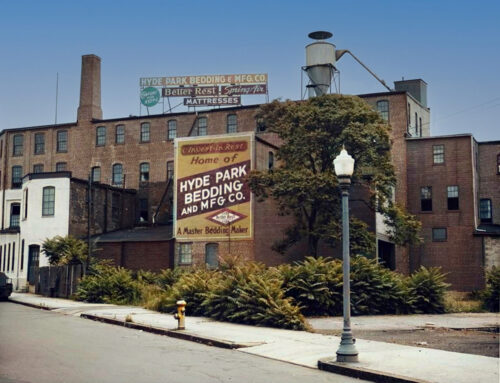
Historic photographs show a massive brick factory complex occupying a landscape that today feels completely different. Modern aerial views reveal student housing, parking and campus facilities where industrial buildings once dominated the neighborhood.
That contrast is what makes this story so remarkable: almost nothing in the present-day appearance of the area hints that hundreds of Reading residents once entered a mill here to produce silk stockings sold around the country.

Reading made it.
Reading forgot it.
Noe-Equl once sent Reading-made silk hosiery across the United States. Princess Royal carried the business into the 1930s. Bowers turned the old mill toward modern industry. The Army filled the same floors with soldiers, classrooms and supply rooms. Albright College eventually transformed the land again.
Today the factory is gone—but the story of 12th and Bern Streets remains a powerful reminder that familiar places can contain entire lost worlds beneath the surface.


Leave A Comment