
Who Had the Best Cheesesteak in Berks County in 1984?
Suds Kroge and Dregs Donnigan ate their way across Reading and Berks County — and put 15 local cheesesteaks through a blind taste test. The results were not what they expected.
In 1984, two Reading-area schoolteachers better known as Suds Kroge and Dregs Donnigan published a wide-ranging guide to eating in Reading and Berks County. Among the book's many features was one especially memorable experiment: a blind taste test designed to tackle a question that can still start an argument almost anywhere in Berks County — who makes the best cheesesteak?
The book was titled Eat! An Outrageous Value-Rated Guide to Reading & Berks Eats. Published in November 1984, it was far more than a cheesesteak guide. Suds and Dregs reviewed expensive restaurants, moderate restaurants, inexpensive places, ethnic food, outlet-area eateries, hot dogs, bread, pretzels, beer and plenty more.
Their goal was not to present themselves as sophisticated restaurant critics. Quite the opposite. Their writing was intentionally irreverent, funny and sometimes merciless. They said they wanted to find good places and good things to eat, provide readers with a few laughs and demonstrate something they already believed strongly: Berks County was one of the great eating values in the world.
Who Were Suds and Dregs?
Suds Kroge and Dregs Donnigan were teachers at a suburban Reading high school who became unlikely local celebrities through their exhaustive — and humorous — investigations of Berks County's bars and restaurants.
Before Eat!, they had already written The Bars of Reading and The Bars of Berks County.
Their adventures attracted attention far beyond Pennsylvania. Calvin Trillin wrote about them, and they were mentioned or featured by publications including The New Yorker, USA Today, The Boston Globe and The Baltimore Sun. They even appeared with Johnny Carson on The Tonight Show.
What made their work unusual was that they treated ordinary local food with the same enthusiasm other writers might reserve for fine dining. A sandwich shop, neighborhood tavern or inexpensive lunch counter could earn their highest praise if it delivered what they called good “Bang-for-the-Buck.”
The Plan: Cheesesteaks for Lunch, Italian Sandwiches for Dinner
The cheesesteak test began with what sounded like a simple idea: get some friends together, gather sandwiches from well-known shops around Reading and Berks County, and determine which one was best.
One of the authors had recently eaten a cheesesteak at the famous Pat's in South Philadelphia and came away unimpressed. The conversation quickly turned into a bit of Berks County pride. In their opinion, Philadelphia cheesesteaks were overrated, and the Reading area had sandwiches that could compete with them.
Their original plan was ambitious. They would conduct a blind tasting of 15 cheesesteaks at lunch and then return to the table for 17 Italian sandwiches at dinner.
That plan did not survive lunch.
After consuming sizable portions of 15 different cheesesteaks, the panel refused to continue with the planned Italian-sandwich dinner. Suds and Dregs joked that the testers expected to spend the next several hours traveling between the couch and the bathroom.
The Italian-sandwich portion of the experiment therefore had to wait for another day.
How the Blind Taste Test Worked
For all of the humor surrounding the experiment, the tasting itself was surprisingly organized.
The panel consisted of six veteran junk-food devotees. Each person sampled a substantial piece of every cheesesteak.
The sandwiches were identified only by letters. The only person who knew which shop had made which sandwich was a moderator who did not participate in the tasting.
The panel judged each sandwich on four areas:
All of the sandwiches were served on soft rolls and without peppers. They were kept warm in foil or reheated briefly in a microwave.
And in true Suds-and-Dregs fashion, the panel attempted to keep its taste buds refreshed by consuming what the authors described as massive quantities of Chesterfield Ale between courses.
Everyone Thought Augie's Would Win

Before the sandwiches were identified, the expectation around the table was that Augie's would win easily. One of the authors had recently eaten a cheesesteak from the famous Pat's in South Philadelphia and had come away disappointed, remarking that Augie's was far better.
That made the blind-test result one of the biggest surprises in the entire experiment.
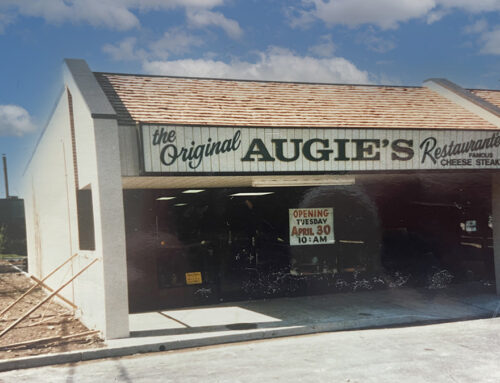
Augie's finished 14th out of 15 with a score of 9.3 out of 20. The panel's criticism focused on the sauce, which they said tasted spoiled, and onions they felt overwhelmed the sandwich.
The authors also added an important footnote beside the result: “Return visits have confirmed downslide.” In other words, Suds and Dregs were not saying that one bad sandwich had simply ruined Augie's showing. Their later visits apparently reinforced their impression that the cheesesteak had declined from the quality and reputation they had known previously.
That did not mean Augie's performed poorly across the board. In the separate Italian-sandwich test, Augie's turned the tables completely and finished first overall with a score of 19.1 out of 20.
The Complete 1984 Cheesesteak Rankings
| Rank | Shop | Location | 1984 Price | Score / 20 | Comment |
|---|---|---|---|---|---|
| 1 | Bob's | Sinking Spring | $2.25 | 18.0 | A cut above the rest. |
| 2 | J's | Reading | $2.01 | 17.9 | Great taste but slightly overdone. |
| 3 | Intel's | Laureldale | $2.05 | 17.6 | Loads of meat but sauce lacking. |
| 4 | Sammy's | Hyde Park | $1.86 | 17.4 | Still good after all those years. |
| 5 | Santo's | South Reading | $2.12 | 17.1 | Great flavor but needs more sauce. |
| 6 | Maple Springs | Reading | $2.28 | 16.5 | Some pieces of meat bit back. |
| 7 | V&S | Shillington | $1.44 | 16.4 | Are we having a sauce shortage? |
| 8 | Mario's | Sinking Spring | $2.92* | 15.5 | Cheese had strange mayonnaise aftertaste. |
| 9 | Speedy's | West Lawn | $2.17 | 13.8 | “John Wayne” meat — dry and tough. |
| 10 | Screpesi's | Lancaster Avenue | $2.28 | 13.0 | Alpo-ish flavor. |
| 11 | Tack's | East Reading | $1.80 | 11.1 | Unmelted cheese and strange taste. |
| 12 | Sarti's | Reading | $1.85 | 10.7 | The pits. Steak was A.W.O.L. |
| 13 | Big John's | Glenside | $2.00 | 10.5 | Plenty of cheese & pickles but not much else. |
| 14 | Augie's | Reading | $1.85 | 9.3 | Sauce tasted spoiled. Onions overwhelming. |
| 15 | Sunny's | Lancaster Pike | $1.90 | 7.2 | The panel delivered the harshest verdict of the test. |
Note: Mario's price was for a large sandwich. The book also noted that Speedy's had improved drastically under new management, while return visits to Augie's had confirmed what the authors described as a decline.
Bob's — Sinking Spring
The panel called Bob's cheesesteak simply: “A cut above the rest.”
It defeated J's of Reading by the smallest possible margin: 18.0 to 17.9.
Some Familiar Names Survive
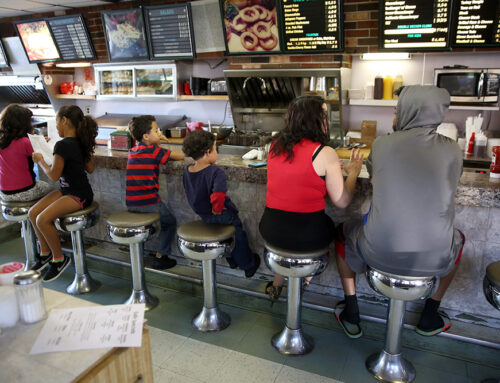
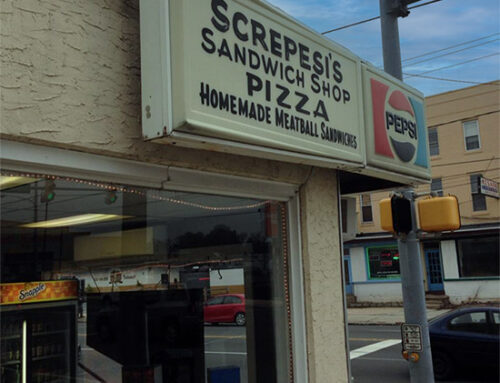
Four decades later, some of the names appearing in the 1984 experiment remain familiar to Reading-area sandwich lovers. The photographs below help connect the cheesesteak shops remembered by Suds and Dregs with the businesses and signs remembered by later generations.

Sammy's — Hyde Park
Sammy's had one of the strongest showings in the blind test, finishing fourth with 17.4 points. The panel's comment — “Still good after all those years.”

V&S — Shillington
V&S finished seventh with 16.4 points. At only $1.44, it was also among the least expensive cheesesteaks in the test. The panel liked it enough to place it in the upper half but jokingly wondered whether there was a “sauce shortage.”

Tack's — East Reading
Tack's represented East Reading in the test and finished 11th with 11.1 points. Its $1.80 cheesesteak was criticized for unmelted cheese and an unusual taste — proof that even beloved local institutions were not protected from the Suds-and-Dregs treatment.
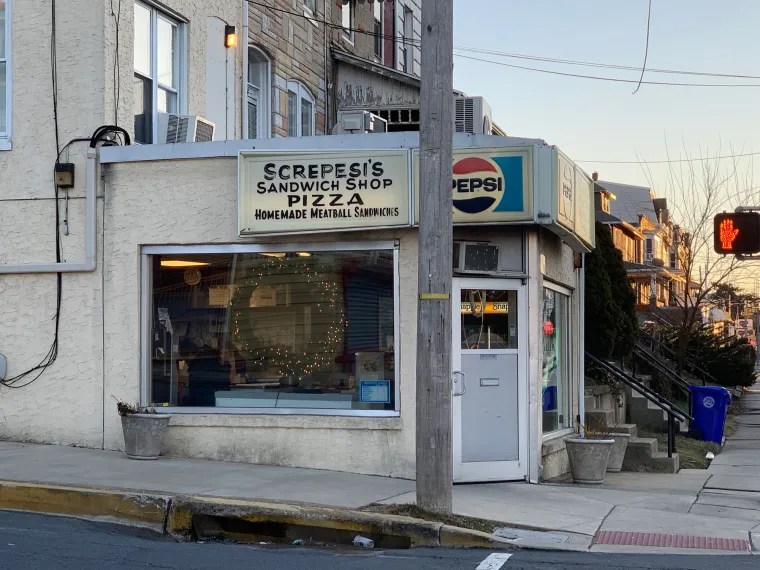
Screpesi's — Lancaster Avenue
Screpesi's ranked 10th with 13.0 points. The panel was unusually blunt about the flavor, but Screpesi's is also one of the names from the 1984 list that remains immediately recognizable to generations of Reading-area sandwich customers.
The Second Test: Italian Sandwiches
Once everyone's stomach had recovered, Suds and Dregs returned for the second half of their experiment: 17 Italian sandwiches, hoagies, zeps and heroes.
Here the results changed dramatically.
The cheesesteak disaster at Augie's did not carry over to the Italian-sandwich competition. In fact, Augie's finished first, scoring an impressive 19.1 out of 20.
Speedy's of West Lawn was second with 18.2, followed by Intel's of Laureldale at 16.7, Big John's of Glenside at 16.6 and Tack's of East Reading at 15.6.
That result also demonstrates why the blind-test format was so interesting. The panel was not simply ranking restaurants by reputation. A shop could perform poorly in one category and dominate another.
What a Cheesesteak Cost in 1984
Looking at the price column today is almost as interesting as looking at the rankings.
Most of the small cheesesteaks tested by Suds and Dregs cost somewhere between about $1.80 and $2.30.
V&S was only $1.44, while Bob's winning sandwich cost $2.25.
That was central to the entire philosophy of Eat!. Suds and Dregs were obsessed with value. Their favorite restaurant was not automatically the fanciest, most expensive or most fashionable establishment.
What mattered was whether the customer walked away feeling the food had been worth the money.
More Than a Cheesesteak Contest
It would be easy to look back at Eat! simply for its humorous restaurant reviews, but today the book has another value that its authors probably never intended.
It has become a snapshot of the Reading and Berks County restaurant world of 1984.
Its pages preserve the names of neighborhood restaurants, sandwich shops, bars and lunch counters that once formed part of everyday life throughout the county.
Some survived. Some changed hands. Others disappeared completely.
The cheesesteak experiment alone preserves a remarkable list: Bob's, J's, Intel's, Sammy's, Santo's, Maple Springs, V&S, Mario's, Speedy's, Screpesi's, Tack's, Sarti's, Big John's, Augie's and Sunny's.
For people who grew up in Reading and Berks County, those names can evoke memories that have little to do with restaurant criticism — stopping for dinner after work, picking up sandwiches for the family, eating with friends, or having a favorite shop whose cheesesteak was unquestionably the best regardless of what any six-person panel said.
So Who Had the Best Cheesesteak?
According to the 1984 blind test conducted for Suds Kroge and Dregs Donnigan's Eat!, the answer was:
Bob's of Sinking Spring
J's of Reading was only one-tenth of a point behind.
Of course, asking Reading and Berks County residents to accept a single answer to the “best cheesesteak” question may be asking too much.
Forty-plus years later, the argument is probably still more fun than settling it.


Leave A Comment