The Reading Railroad We Remember — and the Reading Railroad Workers Actually Knew
Reading loves to remember the locomotives, the shops, the jobs and the glory days. But behind that nostalgia was a powerful corporation that fought unions, pursued monopoly power, disrupted the city and left generations of workers exposed to asbestos.
Mention the Reading Railroad around Reading, Pennsylvania, and the memories usually come quickly.
The locomotives.
The diamond-shaped Reading logo.
The Outer Station.
The passenger trains.
And, perhaps more than anything else, the Reading Railroad Shops.
Generations of Reading families had fathers, grandfathers, brothers and uncles who went through those shop gates every morning. Those men were machinists, boilermakers, electricians, carmen, blacksmiths, painters, pipefitters, laborers and apprentices. They repaired locomotives. They rebuilt locomotives. They maintained passenger cars and freight cars. They kept one of America's great railroad systems moving.
There is an understandable pride attached to that history. And there should be. But over the years, we may have painted such a rosy picture of the Reading Railroad that we have forgotten an important distinction:
The workers deserve our admiration. The corporation does not automatically deserve the same devotion.
The Reading Railroad provided thousands of jobs and contributed enormously to Reading's growth. But the Reading Railroad was not a charitable organization created to take care of the people of Reading. It was a corporation created to make money. And whenever the interests of the corporation collided with those of its workers — or even with those of the city itself — the historical record tells a much more complicated story than railroad nostalgia usually does.
The Reading Shops Helped Build a Railroad City
To understand why Reading residents still feel such an emotional connection to the railroad, you first have to understand the scale of its presence here.
The Philadelphia & Reading Railroad began operating out of Reading in 1842, and from that point forward the railroad became intertwined with the history and culture of the city. The shops were there almost from the beginning.
Under railroad leader G. A. Nicolls, the first shop facilities were established in Reading during the railroad's earliest period of regular operation. The original Philadelphia & Reading shop complex was located around Seventh and Chestnut Streets. Over the decades the complex continually changed in its location, size, equipment and responsibilities.
One of the buildings at the northwest corner of Seventh and Chestnut Streets had served as the first Philadelphia & Reading depot in Reading. Part of the structure was also used as an office for the Reading Shops, while numerous additional shop buildings occupied the surrounding area. And it did not take long for those first facilities to become inadequate.
By the 1850s, the railroad had erected what were then considered its "new" car shops on North Sixth Street in Reading. Those shops replaced the increasingly outmoded and overcrowded facilities at Seventh and Chestnut Streets. The substantial stone shop buildings survived long after their original purpose had changed, continuing to be used for secondary railroad functions.
That early expansion tells us something about how quickly the railroad was growing in Reading. Within little more than a decade of beginning regular operations, its original facilities were already too small for the work being demanded of them. The railroad's physical footprint was growing along with the city.
The Railroad Was Literally in the Middle of the City
By the 1870s, the relationship between the Reading Shops and the surrounding city could be seen almost literally at street level.
An 1871 photograph shows Philadelphia & Reading six-wheel switcher No. 334 sitting across Franklin Street while working the shop area.

The image is remarkable because it captures the railroad and the neighborhood existing side by side. Shop buildings can be seen on one side of the scene. Neighborhood buildings stand nearby. And directly between them sits a working steam locomotive blocking a city street.
This was not an industrial complex hidden miles outside Reading. Locomotives, railroad shops, workers, homes, businesses and public streets existed almost on top of one another. A locomotive performing ordinary shop duties could physically block Franklin Street.
That proximity helped make the railroad an inseparable part of Reading's identity. But it also helps explain why railroad operations increasingly became a source of friction as the city grew. The railroad wasn't simply in Reading. In portions of the city, the railroad occupied Reading.
An even earlier photograph makes that relationship especially clear. One of the earliest known photographs showing the Reading Railroad in the city looks south along Seventh Street from approximately Franklin Street in the late 1840s or early 1850s.
The original Reading Shop complex dominates one side of the scene. Across the tracks stood the Jefferson House hotel, originally built by Lewis Kirk. Nearby were ordinary neighborhood buildings and the property identified in the photograph's caption as St. Peter's Catholic Cemetery, the burial place of many laborers who helped build the Philadelphia & Reading Railroad. Farther south, the ornate cupola of the railroad's main erecting shop at Seventh and Chestnut Streets rises above the surrounding structures.
The photograph is a remarkable reminder of just how tightly everything was packed together.
Railroad.
Hotel.
Homes.
Cemetery.
Shops.
Public streets.
People lived, worked, worshiped and buried their dead within sight and sound of locomotives and railroad shops.
The Railroad's Growth Came at a Cost to Its Neighbors
The railroad's presence in downtown Reading was already creating serious problems almost from the beginning.
Reading's early Catholic congregation had been considering enlarging its small church as early as 1836. But by the 1840s something new had appeared directly opposite the little Catholic church on South Seventh Street: the Reading Railroad's depot and workshops.
At first, the railroad apparently caused little interference. Then its business increased. More locomotives. More trains. More shop activity. More noise.
According to the church history, the increasing railroad business eventually became so disruptive that the incessant noise interfered with divine services. The congregation could no longer conduct worship with the silence and solemnity parishioners expected. This wasn't simply somebody complaining that trains were annoying. There was a real consequence.
In 1845, the church and graveyard on South Seventh Street were sold to Jacob Miller for $3,000.

That is an extraordinary part of the Reading Railroad story. We frequently say the railroad helped build Reading. It did. But its expansion could also make life increasingly difficult for people and institutions that had already been there. In this instance, the railroad's depot, workshops and increasing traffic became part of the reason an existing religious congregation found its location increasingly unsuitable.
And apparently the experience remained vivid in local memory for decades. In 1886, an elderly woman who had known Reading's original primitive Catholic chapel was asked to record her recollections so that the history of the early church could be preserved. Instead, she reportedly became so distressed recalling the disturbance railroad traffic had caused to religious services along Seventh Street that she would talk about little else. As a result, an opportunity to preserve valuable information about Reading's early Catholic history was lost.
More than forty years had passed. Yet what remained strongest in her memory was the railroad. That says something.
The Reading Railroad brought employment. It brought investment. It brought transportation. It brought economic growth. But it also brought noise, disruption and enormous industrial activity directly into an existing neighborhood. The earliest photographs of the area make that reality difficult to ignore.
This was not a railroad built safely beyond the edge of town. It was built directly into Reading. And sometimes the people who were already there were expected to adjust to the railroad rather than the railroad adjusting to them.
The Old Shops Didn't Simply Disappear
As the railroad expanded and newer shop facilities were developed in northern Reading, some of the original downtown shop buildings took on new uses.
The Parrish Pressed Steel Company purchased some of the former railroad shop properties and used the old depot and shop-office building at Seventh and Chestnut as an office.

It was a physical reminder of an earlier generation of railroad operations — a surviving structure from the days when the Philadelphia & Reading's industrial presence was concentrated much closer to the heart of downtown. But eventually even that disappeared. In 1927, the buildings on that block were demolished to clear the site for the new Franklin Street Station and its parking lot.
So the evolution of the Reading Shops can almost be followed through the changing geography of the city: the early depot and shops at Seventh and Chestnut, the new car shops on North Sixth Street, the gradual movement and expansion of railroad facilities northward, and eventually the massive industrial complex that became synonymous with the Reading Railroad itself.
The Shops Became Enormous
As the railroad grew, its Reading operations expanded far beyond that original downtown shop complex. Eventually, the bulk of the great Reading Shop complex was located north of Oley Street. By then this wasn't simply a place where somebody occasionally repaired an engine. It was a massive industrial operation.
A remarkable glimpse of its scale comes from the dedication of Reading's new Franklin Street Station in 1930. A Reading Company official told the crowd that the company's employment in Reading had grown to more than 6,000 people and described Reading as the location of the railroad's principal shops for maintaining its equipment.
The company had recently undertaken a huge modernization program. It included improvements to the locomotive shops and the addition or modernization of car shops, frog and switch repair shops, paint shops and storehouses. The railroad reported spending approximately $4 million within Reading's city limits during the preceding three years — an enormous investment for the late 1920s.
That helps explain the nostalgia. When thousands of families are receiving paychecks from one employer, that employer becomes more than a business. It becomes part of the identity of the city. Neighborhood stores depended on those paychecks. Restaurants depended on them. Landlords depended on them. Children grew up assuming that they might someday follow their fathers into the shops. And the Reading Shops developed a reputation for extraordinary craftsmanship.
The Shop Complex Became a City of Its Own
By the twentieth century, the Reading Shops had grown far beyond a handful of repair buildings. A major improvement program in 1925 added a new freight-car shop and freight-car office, constructed a new coaling tower and included the regrading of the northern section of the Reading Yard.
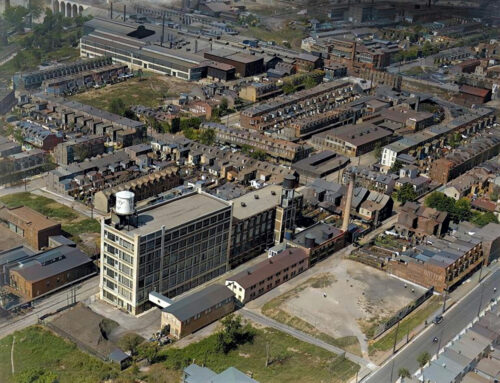
By the early 1950s, the industrial landscape along North Sixth Street included the locomotive shops, freight-car shop, roundhouse, old wheel shop, Water Station, coaling facilities, storage tracks and an enormous web of yard tracks. This was essentially an industrial city inside Reading.
Steam locomotives arrived for repair. Freight cars were rebuilt. Engines were turned on the roundhouse turntable. Workers moved locomotives around the complex.
One of the more interesting pieces of equipment used for that purpose was locomotive No. 1251, a small but powerful 0-6-0 saddle-tank engine built by the Philadelphia & Reading Railway in the Reading Locomotive Shops in 1918. Long after diesel switchers had taken over most yard-switching duties, No. 1251 continued working as the Reading Shops' "shop goat," moving large locomotives and equipment around the complex. Photographs from July 1954 show the engine sitting on the Reading roundhouse turntable.

The little locomotive even had an unusual distinction. It was reportedly the only steam locomotive on the Reading permitted to operate with a one-man crew, and the employee assigned to it was said to have treated the engine almost like a child.
That small detail says something about the human side of the shops. These weren't anonymous factories filled only with machinery. Workers spent years with particular engines, tools and pieces of equipment. They developed skills around them. They developed routines. Sometimes they even developed affection for the machines they worked with.
Reading Didn't Just Repair Locomotives — Reading Built and Rebuilt Them
Some remarkable machinery came out of those shops. During the 1940s, Reading shop workers transformed older I-10sa locomotives into the famous T-1 class, locomotives that would later become some of the most recognizable steam engines associated with the Reading Company.
The scale of that work was impressive. In 1947, locomotive 1970 underwent a complete rebuild at the Reading Locomotive Shops. At essentially the same time, 30 I-10sa locomotives were being rebuilt into the famous T-1 class. These weren't simply mechanics replacing worn bearings. These were skilled craftsmen undertaking enormous locomotive reconstruction projects.
Steam-locomotive construction in Reading continued remarkably late. The last steam locomotive built by the Reading Railroad at the Reading Locomotive Shops was Pacific No. 219, a G-3-class 4-6-2 completed in June 1948. The Reading Shops had also built locomotive No. 1251 in 1918, demonstrating that the facility wasn't simply a repair shop but possessed the ability to construct railroad equipment itself.
That is something worth celebrating. But there's an important distinction.
The corporation didn't build those locomotives. People did.
Machinists built them.
Boilermakers built them.
Welders built them.
Electricians built them.
Blacksmiths built them.
Laborers helped build them.
Apprentices learned from older craftsmen and eventually replaced them.
Those people are the reason the Reading Railroad acquired its reputation.
The Reading Shops Worked for Other Railroads Too
The craftsmanship in Reading was valuable enough that the shops did not limit themselves to Reading Company equipment. The railroad performed construction and maintenance work for other companies. Some Central Railroad of New Jersey steam locomotives were built in the Reading Locomotive Shops, and even in the 1970s, Reading workers were refurbishing Budd RDC cars and other equipment for Amtrak.
That is an important part of the shops' legacy. The work performed there outlived the classic steam era. The skills that generations of Reading craftsmen developed continued to have value even as steam gave way to diesel locomotives and passenger service changed dramatically. The Reading Shops weren't merely where broken Reading Railroad equipment went to be fixed. They had become a major center of railroad craftsmanship.
The Yard Changed With the Railroad
The shops did not exist separately from Reading Yard. They were part of a much larger railroad ecosystem. At the northern end of the yard stood Water Station, near Hiester's Lane and Sixth Street. The area served as the throat of Reading Yard, where passenger trains, freight trains and countless shifting movements could be observed.
The railroad also maintained an extensive water system to support steam operations. A reservoir located on higher ground supplied water by gravity to the yard's water plugs, while another reservoir below collected water that could be pumped back uphill, creating a circulating system designed to reduce waste. When dieselization was completed, those reservoirs became unnecessary and were eventually abandoned.
That transition was happening visibly during the early 1950s. Steam locomotives still worked throughout the yard. Diesels increasingly stood beside them. Some steam engines remained active. Others sat in storage awaiting the scrapper's torch. The Reading Shops were living through the end of one technological age and the beginning of another.
And Reading Eventually Sacrificed Part of the Old Shops to Its Own Expansion
The railroad complex had always been changing. By the late 1920s, the old downtown machine-shop area was already giving way to newer facilities and other railroad needs. The railroad demolished its former machine shop to make room for the second Franklin Street Station, which opened on February 25, 1930. The older structures at Seventh and Chestnut had already been razed in 1927 as part of the same general transformation of the area.
Meanwhile, the center of gravity of the massive shop operation had moved northward. The Reading Railroad had gone from overcrowded facilities at Seventh and Chestnut Streets in the 1840s and 1850s, to new car shops on North Sixth Street, and eventually to an enormous industrial complex with locomotive shops, a roundhouse, wheel shop, freight-car shop, coaling facilities, storage tracks and related yard operations.
It was one of the institutions that defined Reading. That is precisely why what happened inside those shops matters so much. Because while we remember what came out of the Reading Shops, we also need to remember what some workers were breathing inside them.
Then There Was Asbestos
Perhaps nothing complicates the romantic image of the Reading Shops more than asbestos.
Asbestos was enormously useful to the railroad industry. It resisted heat. It resisted fire. Steam locomotives produced tremendous temperatures. Boilers, fireboxes, steam pipes and other equipment needed insulation. So asbestos-containing materials became part of the environment in which railroad employees worked.
Decades later, federal investigators would document what had been present in Reading. In October 1980, the International Association of Machinists requested that the National Institute for Occupational Safety and Health — NIOSH — investigate the Reading Car Shops, which by then were operated by Conrail. There were concerns about deteriorating asbestos insulation.
But there was another reason for the investigation that should stop every Reading Railroad enthusiast in his tracks. Three retired Reading shop workers had developed malignant pleural mesothelioma. NIOSH investigated their employment and medical histories. All three cases were confirmed. All three men had been machinists. Investigators concluded that their illnesses were consistent with occupational exposure to asbestos at the Reading Shops during the steam-locomotive era.
Thousands of Men Worked in That Environment
This was not a tiny shop employing twenty men. During the steam era, thousands passed through the Reading complex. The NIOSH investigation reported that approximately 4,500 employees per year worked at the Reading facility during steam-engine operations before 1953.
Asbestos-containing materials were used around locomotive boilers and fireboxes and for insulation in railroad cars. By the time investigators arrived decades later, asbestos was still present in insulation around powerhouse boilers and heating mains throughout portions of the shops. Some of it was badly deteriorated. Material was chipping. Flaking. Hanging from pipes.
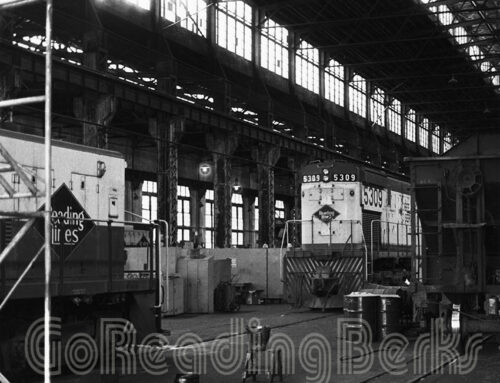
Think again about all those photographs we love. The machinist standing beside a boiler. The boilermaker inside a locomotive. The pipefitter working overhead. The mechanic covered in dirt at the end of his shift. The shop worker standing inside a locomotive being repaired. The men rebuilding engines that would later become museum pieces.
We see craftsmanship. We see Reading history. But there may be something in those photographs we cannot see. Microscopic asbestos fibers.

The Reading Railroad's shops did far more than maintain the company's own locomotives and rolling stock. For decades, Reading craftsmen also performed construction, rebuilding and maintenance work for outside companies — a practice that continued almost until the railroad's final days. That tradition continued well into the diesel era, keeping the facilities busy even as the railroad industry itself was undergoing dramatic change.
Asbestos Didn't Just Threaten the Lungs
Mesothelioma is perhaps the disease most famously associated with asbestos. Asbestos is also an established human carcinogen associated with lung cancer and several other diseases. Research has additionally investigated connections between asbestos exposure and colorectal and prostate cancer.
One systematic review and meta-analysis published in 2020 examined 33 studies involving more than 723,000 people and found an association between asbestos exposure and an increased risk of prostate cancer. Other research has also reported elevated prostate-cancer mortality among asbestos-exposed populations.
The scientific evidence concerning prostate cancer is not as settled as the connection between asbestos and mesothelioma or lung cancer, so it would be inaccurate to claim that every case of prostate cancer among an asbestos-exposed railroad worker was caused by asbestos. But it is accurate to say that published scientific research has found an association between asbestos exposure and increased prostate-cancer risk. Research has similarly examined associations with colorectal cancer.
That matters. Because the workers weren't simply coming home with soot on their clothing. Some were being exposed to a carcinogenic mineral whose consequences might not appear for 20, 30, 40 or more years.
"Nobody Knew Asbestos Was Dangerous" Is Too Simple
Whenever historical asbestos exposure is discussed, one defense comes up repeatedly: nobody knew.
That isn't quite true. Scientific knowledge developed gradually, and today's understanding of asbestos certainly did not exist when the railroad first began using it. It would therefore be irresponsible to claim that every Reading Railroad executive in 1930 knew everything a modern oncologist knows about asbestos. But it would be equally misleading to pretend that industrial medicine remained completely ignorant of asbestos hazards until the 1970s.
Serious occupational disease associated with asbestos was being documented decades earlier. By the time the medical understanding became overwhelming, countless American industrial workers had already accumulated years of exposure. And whatever management knew at any particular date, the people who ultimately carried the physical consequences were the workers.
The corporation could reorganize. Executives could retire. Steam could disappear. The Reading Company itself could disappear. The asbestos fibers inside a worker's lungs didn't disappear with it.
When Workers Organized, the Railroad Fought Them
Asbestos is only part of the uncomfortable history. The Reading Company's relationship with organized labor provides another.
During the severe economic depression of the 1870s, railroad employees faced layoffs, wage reductions and economic uncertainty. Many workers responded by organizing. Reading president Franklin B. Gowen responded by fighting organized labor. The railroad battled the Workmen's Benevolent Association in the anthracite region.
Then employees belonging to the Brotherhood of Locomotive Engineers faced what essentially amounted to an ultimatum: abandon the union or abandon your Reading Railroad job. Hundreds left.
That episode doesn't fit very comfortably into the image of the Reading Railroad as one giant happy family. But it happened.
Then Reading Exploded in 1877
Those tensions helped form the background to the Great Railroad Strike of 1877. Reading became one of the places where the national confrontation turned deadly.
There were strikes. There was property destruction. There were angry crowds. Pennsylvania militia troops entered the city. And in the railroad cut along Seventh Street, soldiers fired into a crowd. People died. Many more were wounded. It became remembered as the Reading Railroad Massacre of 1877.
The railroad did not personally order every shot fired, and the violence was a complicated event involving workers, civilians, government officials and militia commanders. But the economic conflict underlying it cannot be separated from railroad labor relations.
Wage reductions.
Layoffs.
Union battles.
Blacklisting.
Corporate power.
Those things were also part of railroad-era Reading.
Another Reading President Revealed the Attitude at the Top
A generation later, Reading president George F. Baer provided another glimpse of how some corporate leaders viewed labor.
During the great Anthracite Coal Strike of 1902, miners sought improved wages, shorter hours and union recognition. Baer became one of the leading spokesmen for the mine operators. When appealed to on behalf of workers, he notoriously argued that workers' interests would be protected by the "Christian men" to whom God had entrusted the country's property interests.
Workers' interests would be protected by the "Christian men" to whom God had entrusted the country's property interests. George F. Baer, President, Reading Company — 1902
Consider the attitude behind that statement. Workers didn't need enough independent power to challenge management. Management would decide what was good for them. The men who owned and controlled the property knew best. That wasn't brotherhood. That was paternalism.
The Railroad's Interests Could Come Before the City's Too
The tension wasn't limited to employees. As Reading grew, the railroad's physical presence became increasingly controversial. Its tracks ran directly through downtown. Street crossings were blocked. Bridges and crossings complicated traffic. The railroad effectively divided portions of the city.
One agreement concerning railroad property prevented new streets from being opened across railroad territory between Sixth and Eighth streets from Walnut Street north to Hiesters Lane — a span of 18 city blocks.

And George Baer made the railroad's priorities remarkably clear during debates over street openings. His position was essentially that Reading should not place obstacles in the way of the railway and that the city's prosperity depended upon industrial prosperity.
From the railroad's perspective, that made economic sense. But again, it reminds us what the Reading Railroad actually was. A powerful corporation with enormous influence over the physical and economic development of Reading. Not simply a hometown civic organization.
Even the Federal Government Eventually Challenged Reading's Power
The company's influence extended far beyond Reading. Through its railroad and coal interests, the Reading became an extraordinary industrial power in the anthracite region. The company sought control over not simply the transportation of coal but portions of its production as well.
Eventually the federal government intervened. In United States v. Reading Co., the case reached the United States Supreme Court in 1920. Major portions of the Reading corporate combination were found to violate federal antitrust law.
In other words, this wasn't some little hometown railroad operating a few locomotives out of Seventh Street. At its peak, the Reading was part of an industrial combination powerful enough that the United States government went to the Supreme Court to break portions of it apart.
None of This Means the Reading Railroad Did Nothing Good
This is where historical discussions sometimes go wrong. Correcting railroad nostalgia does not require replacing it with another simplistic story.
The Reading Railroad genuinely contributed enormously to Reading. It provided livelihoods for generations. Its payroll supported neighborhoods. It supported stores and businesses. Its transportation network helped Reading industries reach national markets. Its passenger trains connected the city with Philadelphia and beyond. Its shops produced generations of exceptionally skilled craftsmen. And those workers accomplished extraordinary things.
There is nothing wrong with preserving a Reading locomotive.
Nothing wrong with collecting Reading Railroad memorabilia.
Nothing wrong with wearing the diamond.
Nothing wrong with standing beside T-1 No. 2102 and appreciating what an extraordinary machine it is.
Nothing wrong with remembering a little shop engine such as No. 1251 moving locomotives around the turntable.
Nothing wrong with marveling at workers who could rebuild thirty locomotives into an entirely different class.
But appreciating the machine should make us appreciate the men who built it more, not cause us to romanticize the corporation they worked for.
Maybe We've Been Remembering the Wrong Heroes
Look at an old photograph of the Reading Shops. Usually your eyes immediately find the locomotive. Try something different. Look beside it. Find the worker. He's the story.
The machinist leaning against the driving wheel.
The boilermaker preparing a locomotive boiler.
The painter lettering an engine cab.
The apprentice learning a trade.
The electrician maintaining equipment.
The laborer doing the dirty work nobody photographed.
The man working inside a diesel locomotive with its nose door removed.
The employee assigned to the shop goat who supposedly babied the little engine like a child.
The engineer who wanted to belong to a union.
The worker whose paycheck fed a family on South Sixth Street.
The man who retired after thirty or forty years believing he had survived the hardest part of his life.
And the former Reading machinist who learned decades later that he had mesothelioma.
Historical photographs even put names to some of those shopmen. A March 1954 photographic spread identifies machinists, machinist helpers and apprentices preparing locomotive boilers for hydrostatic testing — ordinary Reading workers standing beside the machines that would later become the objects of nostalgia.
Those men built the Reading Railroad. The Reading Railroad did not build itself. Maybe that's the part of the story we've had backwards.
We preserve locomotives. We collect lanterns. We display the Reading diamond. We photograph the surviving stations. We celebrate the glory years. We should. But perhaps the glory belongs less to the corporation and more to the thousands of people who clocked into those shops every day.
Because the Reading Railroad corporation pursued what corporations pursue: profit, growth, market share, control. Sometimes its interests coincided beautifully with Reading's interests. Sometimes they did not. It fought unions. It wielded enormous influence over the city. It became embroiled in bloody labor conflict. Its industrial operations placed workers around asbestos, and federal investigators later confirmed mesothelioma among retired Reading machinists. Research has since associated asbestos exposure with additional cancers, including an increased prostate-cancer risk in some studies.
So, remember —
Remember the Reading Railroad. Remember what it accomplished.
Remember that the shops helped make Reading one of America's great railroad cities.
Remember that more than 6,000 people were once employed by the company in Reading.
Remember the original shops at Seventh and Chestnut.
Remember the little Catholic church whose congregation found railroad noise increasingly impossible to live with.
Remember that the church and graveyard were sold in 1845.
Remember the early photograph showing the railroad shops, hotels, neighborhood buildings and burial ground practically side by side.
Remember the car shops on North Sixth Street.
Remember six-wheel switcher No. 334 sitting across Franklin Street in 1871, with the railroad and the neighborhood practically touching one another.
Remember the massive yard and shop complex of the twentieth century.
Remember the roundhouse. Remember the old wheel shop. Remember Water Station. Remember the freight-car shop. Remember the coaling tower.
Remember No. 1251 moving locomotives around the shop complex.
Remember the workers who rebuilt 30 locomotives into T-1s.
Remember that Reading craftsmen built and repaired equipment for other railroads and were still refurbishing equipment for Amtrak decades later.
Remember the T-1s. Remember the passenger trains. Remember the Outer Station.
But don't paint over the ugly parts simply because the locomotives were beautiful.
Most importantly: remember the workers.
Because when all the corporate histories, stock certificates and annual reports are stripped away, they are the people who made the Reading Railroad legendary.
Go Reading Berks


My grandfather, Raymond Eichner, was an electrician for the P and R. He was electrocuted and lost a thumb at the time, however, over the years, it sent his body on a downward spiral and contributed to his death. He received compensation, enough to pay off the mortgage on the house, but his life was never the same.