At the turn of the 20th century, Reading was humming with knit-goods shops and glove makers. In October 1899, banker–brewer John Barbey and a small group of Reading investors organized the Reading Glove and Mitten Manufacturing Company, starting modestly but with national ambition. That date—1899—has remained the corporate “birthday” for everything that followed.
Like many Reading firms, the company experimented. By the 1910s it was adding silk goods and intimate apparel to its glove trade; the “Vanity Fair” name—first used for lingerie—caught on and soon defined the brand. Corporate histories place the formal rename to Vanity Fair Silk Mills, Inc. in 1920, reflecting the successful pivot into lingerie; during World War II the firm dropped “Silk” from its name as U.S. embargoes squeezed supplies.
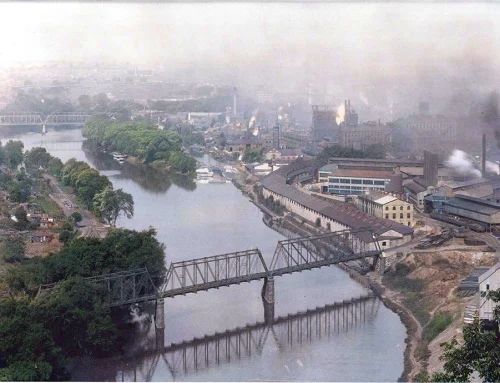
Below: Aerial view of the Vanity Fair factory building showing nearby row homes and other industrial buildings. Founded as the Reading Glove and Mitten Manufacturing Company in 1899 and later known as Vanity Fair Mills, the company later operated as the VF Corporation. View is southeast to northwest. Vanity Fair Mills buildings are on the east side of Coventry Way and south of Buttonwood St. Buttonwood St., Schuylkill Ave. and a portion of the Reading Iron Company, Oley St. mill are visible. Probably taken September 12-16, 1922. Vanity Fair Mills was located near the present day Fine Fare Supermarket.


Management also chased lower-cost production in the South, a pattern seen among many northeastern textile makers. Vanity Fair opened southern plants beginning in the late 1930s; Clarke Mills at Jackson, Alabama (1939) became one of the company’s key early southern facilities and a local industrial landmark. In the postwar reshuffle, the original Reading factory was shuttered in 1948 even as the headquarters remained in nearby Wyomissing—signaling a gradual geographic shift while the brand itself was booming.
The company went public in 1951 as Vanity Fair Mills and, over the next two decades, used acquisitions to broaden beyond intimate apparel. A pivotal year was 1969: Vanity Fair bought the H.D. Lee Company (jeanswear) and renamed itself VF Corporation—an umbrella under which it would assemble a wide portfolio. Around the same time, VF acquired Berkshire International (successor to the storied Berkshire Knitting Mills across the river in Wyomissing), knitting the region’s industrial campus to its future retail experiments.

Berkshire Knitting Mills
That retail experiment became a Reading legend. In 1970, VF tried a Saturday “factory sale” at the old Berkshire mill complex to clear surplus goods. The sale’s success birthed a permanent factory store, then a multi-building destination: the VF Outlet, widely touted as the nation’s first true outlet center and a magnet that helped brand Reading/Wyomissing as the “Outlet Capital of the World.” (Locals still remember the long, low brick buildings and that maze of sale rooms on the Berkshire campus.) The outlet era eventually ended here—Reading’s VF Outlet closed in 2020 and the site was redeveloped as The Knitting Mills—but the concept itself reshaped American retail.

Under the VF banner, the company kept evolving. It moved the corporate headquarters from Wyomissing to Greensboro, North Carolina, in 1998, aligning leadership with large jeanswear operations, then established a shared global headquarters presence in Denver in 2019 as the portfolio shifted toward outdoor and active brands. Over the years VF acquired and built household names—The North Face and Eastpak (2000), Vans (2004), Timberland and Smartwool (2011), and Dickies (2017)—while also pruning: in 2007 it sold the Vanity Fair intimates business (and name) to Fruit of the Loom, and in 2019 it spun off its jeans brands (Wrangler, Lee, Rock & Republic) into Kontoor Brands along with the VF Outlet business.
Even with global reach, the Barbey connection to Reading never vanished. The family remains historically linked to VF’s origins, and family trusts are still notable shareholders. That thread—from a glove-and-mitten startup on the Schuylkill to a modern multibrand giant—is part of why Reading figures so prominently in VF’s corporate memory.
For local industry, the Reading Glove & Mitten/Vanity Fair story illustrates three big arcs: (1) how a small Reading venture rode product innovation (silk lingerie, branded “Vanity Fair”) to national prominence; (2) how regional textile employment gradually shifted south even as headquarters leadership stayed here through the postwar years; and (3) how Wyomissing’s Berkshire campus became the crucible for outlet retail—spawning an entire American retail format and drawing millions of shoppers to Berks County before the property’s 21st-century reinvention.


Leave A Comment