
Hawk Mountain Council, BSA—serving Berks and Schuylkill counties and the Panther Valley region of Carbon County—stands as a local expression of a national movement. Formed in 1970 by the consolidation of the Daniel Boone Council (Reading/Berks) and the Appalachian Trail Council (Schuylkill/Carbon), its history mirrors Scouting’s American arc: a grassroots phenomenon that took root in the 1910s, expanded through mid-century on the strength of camps and community partners, and renewed itself in the twenty-first century with fresh programs, modern facilities, inclusive outreach, and focused land stewardship—all while holding fast to Scouting’s aims of character, citizenship, and fitness.
Origins: Scouting Comes to Berks and Schuylkill (1908–1920s)
Scouting arrived locally almost as soon as it did nationally. In 1908—just a year after Baden-Powell’s Brownsea Island camp—Pottsville’s Lynn G. Adams organized a troop that, following the BSA’s 1910 incorporation, earned him recognition as Pennsylvania’s first Scoutmaster. In Reading, “Lone Scouts” and independently organized troops surfaced under early national charters; in 1911, George M. Jones formed a troop and soon became a central figure in the city’s fledgling Scouting community. The Reading Council was chartered in March 1916 with headquarters in the Reading Eagle building and, by 1919, rechristened the Reading–Berks County Council to reflect growth beyond the city.
Camping began immediately. In 1919 the council opened Camp Indiandale at Vinemont on the grounds of a former South Mountain health resort. Its tent-camp sections—Minsi and Weiser—offered the “real camping” boys craved and seeded a culture of skill, service, and Order of the Arrow (OA) leadership. By the mid-1920s, however, Indiandale’s location along a busy highway and mounting maintenance costs made it unsustainable, ending with a sheriff’s sale in late 1931. Short-term alternatives followed—camping along Manatawny Creek in 1933, use of Schiff Scout Reservation in New Jersey, and other regional sites—until a new, permanent home could be built.

A banner for Indiandale Camp and the Indian symbol used for the camp logo.

Scouts swim in the lake at Indiandale Camp.
Meanwhile, Scouting in Schuylkill County formalized on June 6, 1930, as the Schuylkill County Area Council, first headquartered in Frackville and later in Pottsville. The council already possessed a gem: Camp Wilson, a tract near Summit Station established in 1926. Acquired, improved, and renamed Blue Mountain Scout Reservation in 1931, it quickly became widely admired—by 1933 ranking among the top BSA camps nationwide. The OA arrived early in both counties. At Camp Indiandale in July 1921, E. Urner Goodman installed the nation’s fifth OA lodge, initially Indiandale Lodge (Bison) and later Minsi Lodge 5 (Wolf). Minsi hosted national Grand Lodge meetings in 1923 and 1926. In Schuylkill County, Memeu Lodge 125 (Woodcock) was chartered in 1938, establishing traditions of cheerful service—from a chapel to major camp improvements—that knit youth and adults into a productive brotherhood.
Two Councils, One Culture of Camping (1930s–1960s)
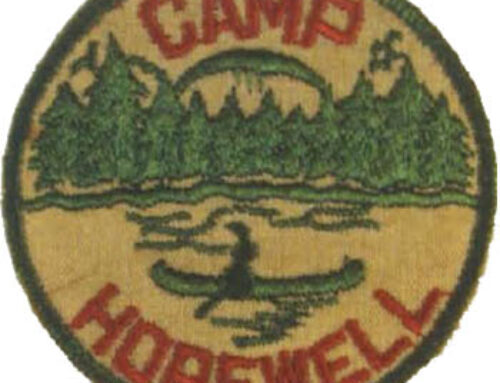
In 1937 Reading–Berks adopted the Daniel Boone name to honor the county’s famous frontiersman and, by 1939, ran Hopewell Camp in what later became French Creek State Park.

The Reading-Berks County Council changed its name to Daniel Boone Council.

Camp Hopewell
As public recreation expanded there after 1946, the council sought a new base and, between 1948 and 1951, assembled Shikellamy Scout Reservation near Bethel. A $1 transfer of a 54-acre tract from Metropolitan Edison seeded the project, which grew to nearly 300 acres through additional acquisitions. A landmark 1950 capital campaign financed core infrastructure—warehouse, latrines, showers, health lodge, administrative building, a tented dining hall, and Lake Good (gifted by contractor C. W. Good). Camps Minsi (central dining) and Pioneer (heater stack) delivered vigorous programs through the 1960s.

A view of the camp Dining Hall from Lake Good, with the waterfront area in the foreground.

1957 Shikellamy Scout Reservation Staff.
In parallel, the Schuylkill council—renamed Appalachian Trail Council in 1940 to reflect growth into the Panther Creek Area—continued refining Blue Mountain Scout Reservation, home to Camp Nisatin (“at the foot of the hills”). Ranger housing, lodges, a pool, trading post, rifle range, improved roads, and upgraded utilities arrived across the postwar decades. A successful 1962–63 capital drive eliminated debt and funded further improvements, leaving Blue Mountain regarded as one of the East’s finest Scout camps by the late 1960s. Both councils cultivated advancement, OA service, and deep community ties: Pine Grove’s early troop hikes to Gettysburg; Troop 3 (Boyertown) earning national visibility at Schiff; Reading units hosting civic parades and citywide Scout Shows; and long-lived unit histories in Kutztown, Wernersville, Leesport, and beyond.
The Merger and a New Identity (1970)
By the late 1960s, national leaders encouraged consolidations to strengthen services and achieve economies of scale. Appalachian Trail Council brought deep membership and a premier camp but faced persistent financial pressures; Daniel Boone Council countered with a modern service center and a broad donor base. After thorough work by joint task forces on growth, administration, program, facilities, and finance—stewarded by leaders such as Woodrow Eshenaur and Joseph H. Jones, Sr.—the two councils merged in 1970 as Hawk Mountain Council. The Kittatinny/Blue Mountain ridge that once divided valleys became the symbol that united them: in 1971, advertising designer Richard F. “Dick” Kurr introduced “Herbie Hawk,” a stylized goshawk mascot whose friendly profile quickly became ubiquitous on patches, publications, and event signage. In the OA, Minsi Lodge 5 and Memeu Lodge 125 merged as Kittatinny Lodge 5—retaining the historic low number and the wolf totem while adopting the ridge’s name.

Dick Kurr presented the original sketch for the 1979 Hawk Mountain Scout Reservation patch to his friend Earl Moyer.Original sketch by Dick Kurr for the 1979 Hawk Mountain Scout Reservation patch.
One Reservation, Many Traditions (1970s–1990s)
For two summers in the early 1970s, the new council attempted to run both Shikellamy and Blue Mountain; staffing and costs soon prevailed, and camping consolidated at Blue Mountain Scout Reservation after 1974. A 1974 capital campaign launched a transformative build-out, with ground broken in April 1976 and a rededication in June 1978. The renamed Hawk Mountain Scout Reservation (HMSR) became the council’s year-round outdoor classroom. Improvements never ceased: a camp road reroute in 1987 improved safety; a central sewage treatment system in the late 1990s met environmental standards; and, beginning in 1989, recurring National Camping School sessions made HMSR a regional training destination. Program identity matured as well. HMSR centered around Camp Meade for Scouts BSA and Camp DuPortail for Cub Day and Resident programs, adding specialty weeks and older-Scout offerings—Trail-to-Eagle, Emergency Services, COPE—and later “Boots and Paddles,” blending Appalachian Trail hiking with Schuylkill River paddling.

Blue Mountain Scout Reservation Patch

Hawk Mountain Scout Reservation
Service Center, Partners, and People
The Krick Estate in Cross Keys—gifted to Daniel Boone Council and used as headquarters since 1959—became the unified council’s service center. Flooding from Tropical Storm Agnes in 1972 spurred renovations, including a trading post, conference center, and a flag plaza supported by Newton W. Geiss and others. In 2007, the facility was rededicated as the Beaver Family Service Center in honor of Howard O. “Mike” Beaver, Jr., whose leadership and philanthropy—joined by his wife Jean and their children Tom and Bonne Jean Riefenstahl—strengthened the council across decades. Signature community partnerships, especially with the Reading Phillies at FirstEnergy Stadium, connected Scouting to the region’s civic life through recruiting kickoffs, overnights, and special outings. Faith communities (Lutheran, UCC, Catholic) and service clubs (Lions, American Legion, fire companies) remained steadfast chartered partners, accounting for roughly three-quarters of local units.

The Daniel Boone Council Service Center at Cross Keys as it appeared in I960, shortly after it was given to the Council by the Krick Estate.

The Council Service Center is pictured in 1971 after the Conference Center and flag poles were added.
Programs, Recognition, and the 2010 Centennial
Through 2010, Hawk Mountain emphasized leader development at all levels—Fast Start, position-specific training, supplemental safety/outdoors courses, and Wood Badge—while youth leadership advanced through Troop Leadership Training and an annual National Youth Leadership Training (NYLT) course (“Wolf’s Lair”). Membership snapshots from the late 2000s show thousands of youth across packs, troops, crews, and posts; camping participation remained strong at Cub Day, Webelos, and Scouts BSA summer camp. The council’s media presence included Scouting Perspectives on BCTV, hosted by F. Darnall Daley, Jr. Milestones included recognition of the council’s 5,000th Eagle Scout—Evan Whildin of Troop 743 (Summit Hill)—in April 2009. The 2010 BSA centennial year became a moment of gratitude and recommitment: a council wide Scout Show opened all program areas and ranges; an Eagle Reunion Dinner with Brig. Gen. John L. Gronski featured a mass rededication to the Scout Oath and Law; and a full contingent attended the National Jamboree at Fort A.P. Hill.
2010–Present: Renewal, Leadership, and Stewardship
The modern era opened with continuity and change. In 2017, James (“Jim”) Milham became Scout Executive, signaling a fresh phase of program stability and growth; in 2023, A. Davis Fox was selected as the next Scout Executive/CEO. Hawk Mountain sustained a strong leadership pipeline, keeping NYLT as a flagship youth course and maintaining robust adult training and commissioner support.
Willits Dining Hall Renovation & Reopening (2018–2020)
Constructed in 1978, Willits Dining Hall—the operational and social heart of HMSR—underwent a comprehensive, two-year renovation culminating in a grand reopening and ribbon-cutting on October 24, 2020. The project:
- Replaced flooring and windows, installed a new electrical system, heating and air conditioning, and a new roof.
- Overhauled the kitchen: removed legacy equipment; dug out and replaced old plumbing lines; installed new refrigeration systems, ovens, stoves, heaters, and commercial kitchen equipment.
- Was powered by more than 5,000 volunteer hours, guided by construction professionals and engineers.
“The Willits Dining Hall renovation project will help Hawk Mountain Scout Reservation continue to serve thousands of youth for another 40 plus years,” said Jim Milham, Scout Executive and CEO. “This project was made possible by many generous donors and countless volunteer hours to fully complete this critical project.”
The hall continues to anchor mealtime traditions—songs, skits, and cheers—and to serve as a center of fellowship for Scouts and volunteers. Its modernization ensures reliable, four-season service for the next generation of campers and leaders.
Camping, Facilities & Ongoing Program
At Hawk Mountain Scout Reservation, summer programs continued with multiple long-term weeks in many years and a familiar slate of program areas: aquatics at both pool and lakefront, climbing/zip-line, ranges, ecology, handicraft, and outdoor skills. The modern layout—Camp Meade for Scouts BSA and Camp DuPortail for Cub programs—supports true four-season use and a steady cadence of council and district events.
Order of the Arrow (Kittatinny Lodge 5)
Kittatinny Lodge 5 maintained its tradition of cheerful service with work weekends, ceremonies, conclave participation, and LLD training—visible in consistent lodge communications and conclave engagement across the late 2010s and 2020s.
Community, Administration & National Context
Post-2010, the council refined policies and transparency (e.g., consolidated cancellation/refund updates) and kept donor engagement strong through Friends of Scouting, special events, and recurring-gift options such as the Herbie Hawk Society. District roundtables, advancement support, and local event calendars underscore organizational health. Nationally, jamborees moved to the Summit Bechtel Reserve (2013, 2017, 2023), shaping how local contingents experience “big Scouting,” with the next jamboree slated for July 22–31, 2026. In May 2024 the national organization announced a rebrand to Scouting America effective February 8, 2025—a change reflected in council communications.
Conservation Milestone (2025)
A defining stewardship step arrived in January 2025, when Hawk Mountain Council and Berks Nature completed a permanent conservation easement safeguarding roughly 670 acres of HMSR. The easement ensures continued camp use while protecting forest habitat, headwaters, and the outdoor classroom that has shaped generations of local youth.
What Makes Hawk Mountain Council Distinct
A camps-first culture. From Indiandale and Blue Mountain to today’s HMSR, the outdoors has been the council’s classroom. OA service, COPE, waterfronts, and specialty treks carry tradition forward even as STEM and trail-and-river expeditions broaden the experience.
Deep community DNA. Faith partners, schools, industries, veterans’ groups, and civic clubs built and sustained the program across generations.
A leadership pipeline. Unit Scouters, commissioners, council officers, and OA youth form a long pipeline of mentors and achievers—reflected in thousands of Eagle Scouts and multi-generation Scouting families.
Character, citizenship, fitness. The aims of Scouting anchor a diverse program: service (from Scouting for Food to thousands of Eagle projects), leadership (NYLT, Wood Badge), and outdoor fitness in an unparalleled ridge-and-valley landscape.
Key Milestones
- 1908: First Pottsville troop organized by Lynn G. Adams.
- 1916/1919: Reading Council chartered; renamed Reading–Berks County Council.
- 1921: OA Minsi Lodge 5 installed at Indiandale; hosts Grand Lodge in 1923 and 1926.
- 1930/1940: Schuylkill County Area Council organized; renamed Appalachian Trail Council; expansion to Panther Creek Area.
- 1939–46: Hopewell Camp era (Berks).
- 1948–51: Shikellamy Scout Reservation acquired and built (Berks).
- 1950s–60s: Blue Mountain (Schuylkill) and Shikellamy (Berks) peak years.
- 1970–71: Merger forms Hawk Mountain Council; OA lodges merge into Kittatinny Lodge 5; “Herbie Hawk” created (1971).
- 1978: HMSR rededicated; Shikellamy sold; Willits Dining Hall constructed.
- 1999–2007: Hafer Chapel (1999); Roedel Science & Technology Center (2002); Marlin Miller Jr. Conference Center (2007); Service Center rededicated as Beaver Family Service Center (2007).
- 2009–2010: 5,000th Eagle recognized (Evan Whildin); BSA centennial celebrations.
- 2017: Jim Milham named Scout Executive (effective Aug. 1).
- 2020: Willits Dining Hall renovation completed; grand reopening & ribbon-cutting Oct. 24.
- 2023: A. Davis Fox selected as Scout Executive/CEO.
- 2024–2026: National rebrand to Scouting America (effective Feb. 8, 2025); next National Jamboree slated for July 22–31, 2026.
- 2025: Conservation easement completed at HMSR protecting ~670 acres.
Epilogue: Enduring Values, Renewed Commitments
From 1908 patrols in Pottsville and 1916 Reading Council rooms to today’s Beaver Family Service Center and a year-round HMSR campus, Hawk Mountain Council has adapted without compromise—modernizing camps and training while preserving the essence of Scouting. With a legacy of more than 5,000 Eagle Scouts through 2009, a decade and a half of continued leadership development, a landmark conservation easement in 2025, and the revitalized Willits Dining Hall at the heart of camp life, the council enters its next chapter under the Scouting America banner ready to Be Prepared for the adventures still ahead.




Leave A Comment