It was a warm Saturday morning in June 1914, and Sarah Mitchell stood at Fifth and Penn Streets in downtown Reading, clutching her fare for the Temple line. The bustling intersection—where nearly every trolley line in Berks County converged—hummed with activity. The familiar clang of bells announced the arrival of her trolley, one of the cars serving the thriving village of Temple.
As the large electric car rolled to a stop, Sarah climbed aboard, greeted by Conductor Brunner, who knew all his regular passengers by name. He’d make sure she got off at the right street corner—that kind of personal service was what made the trolleys special.
The car filled with other passengers: mill workers, families heading to Temple for shopping, and residents returning home after business in Reading. Sarah settled into her seat as the trolley lurched forward with its characteristic whir, leaving the bustle of Penn Street behind.
The Route to Temple
“A short ride and a single fare to any part of Reading,” the advertisements promised, and Temple was perfectly positioned right on the trolley line. As they headed north from the city center, Sarah watched Reading’s neighborhoods pass by the windows. True to the city’s reputation, there was “a trolley line within reasonable walking distance of every neighborhood in Reading.”
The trolley swayed gently as it traveled along its route, the motors humming steadily beneath the floorboards. Frank Sprague’s revolutionary design—with motors suspended from axles and mounted on springs—meant the ride was remarkably smooth, even over the occasional bump in the track.
Within minutes, they approached Temple. Sarah could see how the village had transformed since the trolleys arrived. New homes lined streets that hadn’t existed a decade ago. Businesses were thriving. The trolley had brought Temple into Reading’s orbit, making it easy for residents to commute to work in the city’s mills and factories, and for city dwellers to visit Temple’s shops and homes. The village was no longer isolated—it was connected.
Below: Route 15A was the shortened version of Route 15, which originally operated from Temple to 5th and Penn Streets. The full Route 15 began on Penn Street, continued up 4th Street to Washington, then followed Washington to 6th Street, 6th Street to Richmond, and Richmond to Hiester’s Lane. From there, it ran over a private right-of-way through Northmont, Spring Valley, and Laureldale before reaching Temple. On May 1, 1939, all service north of Elizabeth Avenue in Laureldale was discontinued. The new eastern terminus, designated “Rosedale” by the Reading Street Railway, became the end of the line. From that point on, all Route 15 cars were reclassified as Route 15A.

A Hub of Connections
As Sarah stepped off in Temple, she marveled at what the electric railway system had accomplished. From this very line, connections could be made to reach the far corners of Berks County and beyond. The entire system radiated from Fifth and Penn like spokes on a wheel:
- Northeast to Kutztown (and eventually to Allentown) – 25 miles
- East to Boyertown – 22 miles
- West to Womelsdorf – 15 miles
- Southwest to Mohnton – stretching into the countryside
- Southeast to Birdsboro – 10 miles
People from Temple could access the recreational wonderland of Carsonia Park, built by the trolley company itself. Church groups and Boy Scout troops chartered trolleys the way modern groups would one day charter buses. Every Sunday in summer, trolleys filled with people heading to Kutztown for picnics, volleyball, and baseball, or south to the playland of Carsonia Park.
The Return Journey
After completing her errands, Sarah waited at the Temple stop for the return trolley. It arrived promptly—the system was reliable, with regular service throughout the day. She climbed aboard and settled in for the short ride back to Reading.
As the trolley glided back toward Fifth and Penn, Sarah reflected on how much the electric cars had changed life in Berks County. The system carried 19 million passengers annually. It was clean, efficient, and affordable—accessible to working people, families, and anyone who needed to travel.
Through the window, she could see the growth the trolleys had sparked. As The Story of Berks County would note in 1916: “Trolley lines have stimulated building operations in suburban towns to a remarkable degree and gave the sections through which they passed a splendid service in handling passengers, freight and mail.”
Back at Fifth and Penn within the hour, Sarah stepped off with her packages. The round-trip fare had been modest, and the service had been exactly what she’d expected: reliable, comfortable, and friendly. Conductor Brunner tipped his cap as she departed.
The Last Trolley to Mohnton – January 7, 1952
Nearly four decades later, on a cold Monday evening in January 1952, a very different scene unfolded at the same Fifth and Penn Streets corner where Sarah had once caught her trolley to Temple.
Several hundred people turned out to ride the last trolley to Mohnton—far too many for a single car to handle. J.P. Costello, President of the Reading Bus Company, ordered up a second trolley to appease the crowd that had gathered. But special accommodations were made for company officials, retired trolley motormen and conductors, and friends who wanted to be on that historic final run. The event brought to a close the 78-year history of the Reading Street Railway Co., which began in 1874 with horse-drawn cars.
Below: Passengers boarding street car 807 at 5th and Penn.

The Final Journey Begins
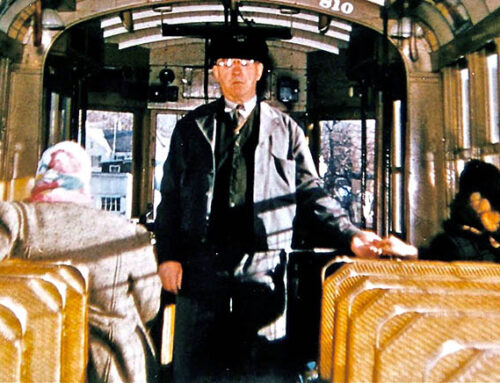
Among those boarding was Edwin R. Brunner, the 69-year-old retiring motorman who had served the line for fifty years—the last 19 on the Mohnton run. Brunner had been the kind of conductor Sarah Mitchell had known all those years ago, the one who looked after children, seeing that they got off at the right stops, or visitors seeking out friends or relatives, or even drunks, making sure they got off at the right street corner. He typified the personal service and care the trolley provided its customers—a concern that would change with the coming switch to buses.
The trolley—a venerable old car with woven cane seats, ornate ceilings, and elaborate light globes—hummed to life one last time. The pole rode the electric line above, and the metal wheels began pounding over the tracks laid in the middle of Lancaster Avenue.
“Auld Lang Syne”
It’s unclear how many fares were collected on the last run, or whether any fares were collected at all. The novelty of the last ride, the joyous crowds along the way, and the clicking of cameras turned the event into a gala affair.
As the trolley traveled its familiar route past Shillington, grade school children stood at the fence and waved farewells. Persons ran from their homes and businesses to say goodbye. The crowd packed inside the trolley sang “Auld Lang Syne,” and this seemed a fitting ending to an era that had been part of the Mohnton, Shillington, and Kenhorst scene for more than six decades.
At the turnout where two trolleys would once stop and wait to pass each other—one heading from Reading to Mohnton, another moving from Mohnton to Reading—the motormen no longer signaled to each other with their warning bells. This journey had no trolley coming the other way.
The End of the Line
When the trolley reached Mohnton and made its final stop, passengers slowly disembarked, many with tears in their eyes. The doors popped open one last time. The 14-cent ride from Mohnton to Reading—the ride that had connected communities, built suburbs, transported workers, and carried millions of passengers over the decades—was now a thing of the past.
Progress, it seemed, had little patience with the slow and the sure. The trolleys were slow and big, and they held up traffic in an age when the automobile was becoming too numerous to tolerate the “clanging giants.” Tempers had flared. Unkind words had been hurled at the trolleys.
But now, as the last trolley sat silent at the Mohnton terminal, those who had come to witness history remembered all the trolley had been: reliable, comfortable, dependable, and above all, personal.
After the Last Run
The streetcars at the terminal would be scrapped. The trolley wires and tracks would be removed. The clanging bell would no longer sound. The high-pitched bells, the rumbling over tracks, the conductors clicking change from their metal coin changers—all would pass into memory.
The Reading & Southwestern to Mohnton had been the last holdout, artificially sustained by legislation and technicalities long after the other interurban lines had “flickered out, one by one” in the early 1930s. After a short 40 years of electric service, Berks County’s age of trolleys was over.
Only memories would survive.
The Benefits Trolleys Provided
Reading and Berks County once boasted one of Pennsylvania’s most extensive trolley systems, providing 78 years of faithful service to the community. Today, only traces remain—rails peeking through street paving here and there, and a few old car bodies used as sheds.
The Benefits Trolleys Provided:
✅ Affordable Transportation: “A short ride and a single fare to any part of Reading”—just 14 cents from Mohnton to Reading, accessible to working people, families, and farmers
✅ Connected Communities: 120+ miles of track (35 miles within Reading, 85 miles suburban, plus mountain lines) linked the entire county, bringing prosperity to small towns like Temple, Kutztown, Shillington, and Mohnton
✅ Economic Development: “Trolley lines have stimulated building operations in suburban towns to a remarkable degree and gave the sections through which they passed a splendid service in handling passengers, freight and mail” (The Story of Berks County, 1916)
✅ Community Growth: “Temple has seen its greatest progress since the place has been connected by trolley roads” (Weekly Reading Eagle, 1903)
✅ Environmental Friendliness: Electric-powered, clean, and efficient—no emissions, no fossil fuels, just reliable electric motors
✅ Reliable Service: Carried 19 million passengers annually at their peak, with frequent, dependable schedules—comfortable and dependable transportation
✅ Personal Service: Conductors like Edwin R. Brunner knew their regular passengers, looked after children to ensure they got off at the right stops, helped visitors seeking friends or relatives, and created a genuine sense of community care
✅ Universal Access: “A trolley line within reasonable walking distance of every neighborhood in Reading” by the turn of the 20th century
✅ Multi-Purpose: Carried not just passengers but freight and mail, supporting local businesses and commerce throughout Berks County
✅ Recreation: Provided easy access to parks, picnic grounds, and recreational areas—Carsonia Park was specifically built by the trolley company to attract riders. Church groups and Boy Scouts chartered trolleys for outings.
✅ Private Right-of-Way: Many suburban trolleys ran on dedicated tracks once outside city limits, meaning faster, smoother travel without competing with other traffic
✅ Regional Connectivity: With connecting lines, you could travel from Reading to Philadelphia, Allentown, and Lancaster—opening up the wider world to Berks County residents
✅ Jobs and Industry: Provided employment for thousands—motormen like Edwin R. Brunner who served 50 years, conductors, maintenance workers, administrative staff—and enabled industrial growth by reliably transporting workers to mills and factories


Leave A Comment