Reading Iron Company
For a century, people in Reading said "the Iron Company" the way they said "the Railroad." But the Reading Iron Company was never one place. It was a working network stretched across the south end, the northwest riverfront, Ninth and Exeter, Buttonwood Street, and five other Pennsylvania towns — plus a mountain of Somerset County coal to keep it fired. And it did not simply "fail in the Depression." In 1936, one hundred years after its founding, it still employed 2,200 men and called itself the largest maker of genuine puddled iron in the world. Four years later a Norristown powder crew dropped its 220-foot stack with thirty pounds of dynamite. This is the map, and the whole story — including the end.

Tap or click any image to enlarge · use ‹ › or arrow keys to browse
Not a building. A system.
If you're looking for the Reading Iron Company on a map, you'll be disappointed by a single pin. The company was a chain of connected operations: blast furnaces that made pig iron, puddling furnaces that refined it into wrought iron, rolling mills that shaped it, tube works that welded it into pipe, nail factories, a foundry and forge that cast and hammered it into machinery, and coal lands two hundred miles west that fed the whole thing.
So this history reads as two stories at once. One is a corporate succession — Keim, Whitaker & Co. becomes Seyfert, McManus & Co. becomes Reading Iron Works becomes Reading Iron Company, and finally a subsidiary of the Reading railroad and coal empire. The other is a geography of production that starts at the foot of South Seventh Street and spreads north along the river, up to Ninth and Exeter, and out to Emaus, Danville, Pottstown, Birdsboro, and Columbia.
We built this from period descriptions, the standard county histories (Montgomery 1898, the 1909 Annals, Fox 1925), The Passing Scene for later site memory — and now a run of newspaper reporting from 1889, 1895–96, and 1937–38 that fills gaps the books left open. Dates and figures stay attached to the source that reported them. Where the record is still silent, we say so. Those spots are marked in boxes like this one; newspaper finds appear as clippings.
Where the canal met the rails
Before the 1830s, iron in Reading meant a blacksmith shop. What changed everything was transportation. The Schuylkill Canal had made the town a shipping point between the anthracite region and Philadelphia, and the Philadelphia & Reading Railroad was under construction. A plant that could take in coal, ore, and limestone by water or rail, and ship finished iron out by either, had an advantage no country furnace could match.
That year Benneville Keim, George M. Keim, James Whitaker, and Simon Seyfert — trading as Keim, Whitaker & Co. — put up the Reading Iron and Nail Works at the foot of South Seventh Street, at the extreme southern edge of town between the Schuylkill and the P&R tracks. The site was chosen precisely so that both the canal and the railroad could carry its freight. This ground became the nucleus of everything that followed; in later years it would be called the Main Works, the South Seventh Street Works, the Tube Works, and, in part, the South Street Rolling Mill.
This was no small forge. The original rolling mill was a heavy frame building about 130 by 166 feet holding seven reverberatory furnaces — four for puddling, three for heating. Its divisions rolled bar, round, square, and flat iron, nail plate, band iron, sheet iron, and boiler iron. Next door stood a two-story brick nail factory, 75 by 90 feet, with about thirty nail-cutting machines on its main floor — cutting everything from 2d nails to 7-inch spikes — and drums, belts, and a grindstone in the basement, which doubled as a storehouse for several thousand kegs. Driving it all was a 180-horsepower stationary steam engine built in Pittsburgh by McClurg, Wade & Co. — remembered as the first large stationary engine in Berks County used to drive manufacturing machinery.
The cooper shop tells you the scale. Nails shipped in wooden kegs, so eight to ten men were employed doing nothing but making containers for the finished product. The works burned 80,000 to 90,000 bushels of bituminous coal and more than 2,000 tons of anthracite a year. Reading Iron's later fame would rest on pipe, but nails and merchant iron were the foundation.


Ernest Hexamer, Hexamer General Surveys, Vol. 10, plates 933–934, surveyed Sept. 1875. Map Collection, Free Library of Philadelphia.
Forty years on, the fire-insurance surveyor Ernest Hexamer drew the same ground. By September 1875 the rolling mill and tube works employed 200 men — 250 when running full — and the surveyor noted what came out of each: merchant iron, nails, spikes, and skelp from the mill; gas pipe and boiler tubing from the tube works. The blast furnaces, a hundred yards off, had about 50 hands; the Steam Forge on North Eighth had 20 on the payroll of a full 50; the Scott Foundry had 175 of a full 250; and the Sheet Mill was “not operated at present.” Roughly 450 men at work, 600 at capacity — in the trough of the depression that followed the Panic of 1873.
The detailed early description gives about 100 hands, five to six tons of nails a day, and ten tons of merchant iron. Later histories looking back on the 1836 works give roughly 250 employees and 26 nail machines. Different years, different departments, rounded figures. What's secure is that from day one this was a mechanized, multi-department operation.
New partners, the first pipe mill, and a date nobody agrees on
In 1846 the firm became Seyfert, McManus & Co. Simon Seyfert and his family stayed in; John McManus, a railroad contractor who had built part of the P&R, came in with other investors. Same works, new partnership — and, from April 7, 1862, a corporate charter behind it (see below).
Two years later came the most consequential addition in the company's history: the first pipe mill, in 1848. It bore no resemblance to modern seamless-tube production. Early butt-weld pipe was heated and drawn so its edges could be joined. Lap-weld pipe followed, with the edges of the skelp — the long strip of rolled iron that pipe is made from — scarfed by hand before welding. Charcoal-iron tubes came a few years after that. That modest department became the enormous Reading Tube Works, because pipe had markets that only grew: gas distribution, municipal water, steam plants, locomotives, oil fields, and eventually long-distance pipelines.
The rest of the chain filled in around it. Furnace No. 1 in 1853; the Scott Foundry and Steam Forge associated with the works in the early 1860s; a Sheet Mill in 1865; Furnace No. 2 in 1874. Furnaces made pig iron; puddling refined it; mills rolled it; tube mills welded it; nail machines cut it; the foundry and forge turned it into machinery. Vertical integration became the company's defining trait — and, much later, its heaviest burden.
Montgomery's 1898 history says the company incorporated as Reading Iron Works in 1862; Fox's 1925 history says the Seyfert, McManus name lasted until 1878. A page of the Pennsylvania House proceedings, reprinted in the Reading Times in March 1868, shows they're both right. The bill under debate was "a further supplement to an act approved April 7th, 1862, entitled An act to incorporate the parties doing business at the Reading iron works, in Berks county, under the name, style and title of Seyfert, McManus and company." Read that title carefully: the legislature incorporated the people running the works, and the corporation's legal name was Seyfert, McManus & Company. "Reading Iron Works" was what the plant was called, not yet what the company was called. The 1875 Hexamer insurance surveys still list the owner as Seyfert, McManus & Co. The name change to Reading Iron Works came later — 1878 by Fox's account — and later histories compressed that renaming into "incorporated in 1878." One more wrinkle: a Berks member in the 1868 debate says the firm had been "incorporated some two years ago," which suggests the partners only organized under the 1862 charter around 1866, after a partner's death made a plain partnership unworkable.
1868: the iron works go to Harrisburg for water
The same proceedings tell you something the county histories skip entirely — what the works were short of in the 1860s. It wasn't ore or coal. It was clean water.
Reading's city water had been sold to the works by a private company until the city bought the waterworks and let the arrangement lapse. Since then the mills had run on Schuylkill River water, which was so hard and so full of lime that the boilers kept scaling up — "a matter not only of great inconvenience to them, but of great expense." The bill, carried by Mr. Jones of Berks, gave Seyfert, McManus & Co. the right to lay pipes through the streets of Reading and to take water from springs and streams outside the city — with the reassurance that any private property crossed would be paid for and that the citizens of Reading had raised no objection.
The second section drew fire. Members from Allegheny and Lancaster feared it was quietly granting a manufacturing company the powers of a bank or a broker; the company, they were told, only wanted to hold the securities of a deceased partner without dissolving the firm, and to invest surplus in mortgages and bonds. The House passed it 49 to 8 after adding a proviso that nothing in the act conferred banking privileges. Along the way the debate notes that the company's charter already had it paying a fixed sum to the state in lieu of a tax on dividends, and that "a large number of men, perhaps several thousand people," depended on the works for their livelihood.
Reading Times, March 20, 1868, p. 2
The crash
The old Reading Iron Works did not collapse because its factories had become worthless. The contemporary reporting paints a more complicated picture: heavy indebtedness, brutal competition, and not enough working capital to keep the furnaces going through a bad market.
Operations were suspended in March 1889. One Reading report insisted the company's assets actually exceeded its liabilities by at least $500,000 — the problem was ready cash, not solvency. Local banks and suppliers were among the creditors. The possibility of help from interests connected with the Philadelphia & Reading Railroad was openly discussed; in the end the railroad did not simply step in and rescue the works.
Newspapers elsewhere argued over what Reading's failure meant. Some said Pennsylvania furnaces could no longer compete with low-cost Southern iron. Others rejected that and pointed instead to plant location, management, ore costs, and above all railroad freight rates.
Reading Times, March 7 and March 12, 1889
The assignee's sale that summer gives us something the county histories never do: an inventory of what "Reading Iron Works" actually contained. The Tube Works held finished pipe, boiler tubes, oil-well tubing, casing, sockets, and fittings. The Rolling Mill had pig iron, puddle and scrap bars, bar and band iron, and ore. The blast furnaces held pig iron, fire brick, cars, and tools from a limestone quarry. The Sheet Mill, Steam Forge, and Scott Foundry each carried their own stocks of blooms, forgings, anthracite and charcoal pig, and scrap. It is almost a photograph of nineteenth-century integrated ironmaking.
At the August 1889 sale, Frank C. Smink — acting for the company that was about to be born — bought nearly everything. One lot alone was 21,856 pounds of finished special-size pipe iron; others ran to thousands of pounds of scrap and damaged pipe. The old corporation was dead. The industrial system was being kept together for its successor.
Reading Times, August 1 and August 7, 1889
Rebirth, and a whistle at the Scott Works
On August 12, 1889, the Reading Iron Company was formally organized. It bought the Tube Works, Reading Rolling Mill, Scott Foundry, Sheet Mill, and Forge from the assignee and immediately began rehabilitating and enlarging them. George F. Baer was the first president; F. C. Smink, treasurer and general manager of the old works, was the central figure in the reorganization; George Schuhmann handled the physical rebuilding and later served as vice-president and general manager.
By August 29 the Reading Times was reporting preparations to resume throughout the works. A steam whistle heard at the Scott Works — then described as being at Eighth and Buttonwood — was taken as proof that production had restarted. In fact it was blown while testing valves that had sat unused for nearly six months. The molding shop was expected to restart soon, the pipe mill was being readied, and a blast-furnace stack was being relined.
Reading Times, August 29, 1889
Rather than retreat, the new company went shopping — and its first purchase was another failure.
Keystone: buying a bankrupt furnace for $100
The Keystone Furnace Company — locally associated with the Bushong name — stood in northwest Reading above the Schuylkill Canal, near the east end of the Lebanon Valley Railroad bridge, between the west ends of Green and Greenwich Streets. In August 1889 it made an assignment for the benefit of its creditors, blaming sharp competition in pig iron and an accumulation of debt. The property was two anthracite blast furnaces, machinery, fixtures, and about thirteen acres.
The following month George F. Baer bought the two furnaces, cars, tools, and roughly ten acres for the Reading Iron Company for just $100 above the existing encumbrances — a $175,000 mortgage held by Reading Trust Company plus unpaid interest. He picked up a small associated tract in Fleetwood at the same time.
Reading Times, August 22, 1889; Philadelphia Inquirer, September 20, 1889
The older histories say only that Keystone was "acquired in 1889." Now we know how: Reading Iron took over a distressed property whose debt had already forced it into assignment, essentially by assuming the mortgage. Once in the system, Keystone became one of the company's main sources of pig and foundry iron and stayed in operation into the late 1930s.
The expansion, dated by the newspapers
In 1895 Reading Iron bought the Montour Rolling Mills at Danville — a complex dating to 1845, and by local tradition the place where the first T rails in America were rolled — and the Crumwold Furnace at Emaus, the older spelling of Emmaus. It was also building an entirely new plant at home.
In November 1895 the company was making alterations at Crumwold and expected, once finished, to run the furnace at about 650 tons a week.
Patriot-News (Harrisburg), November 4, 1895
Oley Street: 1896 is the finish, not the start
The county histories say the Oley Street Mills were "built in 1896." The papers let us do better.
By September 1895 the Oley Street mill department was already in course of erection. Reading Iron was installing gas-heating furnaces and what the report called a new, company-designed system of grateless water-seal producers.
By October 1896 the plant was unmistakably running: the puddling department, idle since August 6, resumed and put about 200 men back to work, with steady employment expected through the winter.
In December 1896 Baer took Philadelphia & Reading president Harris on an inspection of the "new plant at Oley street." Harris's son, George B. Harris, was superintendent of the Oley Street department. The same item places Reading Iron's principal office at 518 Washington Street.
Scranton Tribune, September 2, 1895; Argyle Atlas, October 16, 1896; Reading Times, December 23, 1896
So: under construction by September 1895, operating during 1896, still called "new" at the end of that year. Also in 1896 the company added the former Philadelphia & Reading Rail Mill at Ninth and Exeter, which became the Ninth Street Rolling Mill and was remodeled in 1899 and again in 1902.
Then came a second rebuilding campaign: Montour rebuilt in 1901, a new forge on North Ninth Street in 1901–02 with electric cranes and fifty-ton capacity, a Danville puddle mill bought and repaired in 1905, and the Scott Foundry reconstructed in 1905–06. By 1909 the company reported two blast furnaces rated at about 180,000 gross tons, five rolling-mill plants at about 200,000 tons, and nine tube mills approaching 150,000 tons of tubular goods a year.
Every plant, and where it stood
Seventeen operations across eight localities, grouped by place. The colored edge tells you how each one entered the company: built new, bought from someone else, or inherited from the old Reading Iron Works.
South Reading — the original works
Main Works & Tube Works
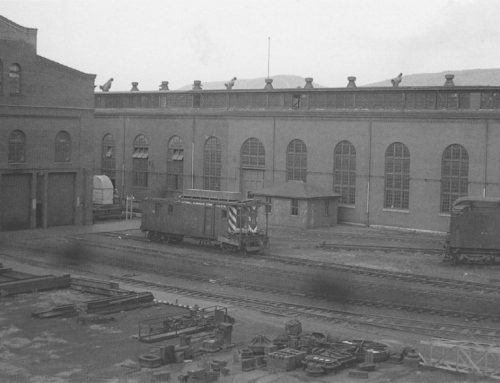
The founding site and nucleus of the company. Nine tube mills by 1908, rated at 150,000 gross tons; about 1,500 employees at the end. Last pipe rolled March 1937; sold to Luria Brothers for scrap July 1940; the 220-foot stack dynamited November 1, 1940. The nail plant here was the last unit in regular operation.
South Street Rolling Mill
Named as a distinct department in 1926 and again in 1937. Whether it was its own parcel or a division of the main works isn't settled.


Aerial and postcard: GoReadingBerks collection. Plate: Hexamer General Surveys, Vol. 10, Free Library of Philadelphia.
Buttonwood Street and the canal side — foundry, forge, sheet mill
Scott Foundry ("Scott Works")
Cotton compressors, sugar mills, blast-furnace engines, boilers, ordnance — Civil War cannon and later the Brown Segmental Wire Wound Gun. Sold to Birdsboro Steel Foundry & Machine in 1938 and kept running under new owners.
Steam Forge → North Ninth Street forge
Marine, engine, and general forgings up to fifty tons. The 1901–02 forge with electric cranes replaced the 1850 original — same name, different building, and evidently a block over.
Sheet Mill
Sheet and plate iron. Idle when Hexamer surveyed it in 1875; listed in the 1889 assignee's inventory and bought by the new company; drops out of the later plant lists.


Ernest Hexamer, Hexamer General Surveys, Vol. 10, plates 935–938, surveyed Sept. 1875. Map Collection, Free Library of Philadelphia.
Northwest Reading — the furnace district
Keystone Furnaces
Two anthracite blast furnaces on about ten acres, bought from a bankrupt company for $100 over its $175,000 mortgage. 180,000 gross tons capacity in 1908. Still listed in 1937; being razed by December 1938.
Oley Street Mills
New puddling and rolling capacity with gas-fired furnaces. Its workers formed the Oley Street Mill Relief Association, with a clubhouse at 156 North Front Street. Ran only occasionally in early 1937; superintendent Charles E. Morgan at the end; scrapped by Luria 1939–40.
Roe Puddling Department
A separate plant with its own superintendent (C. P. Bjorkbom in 1939), assessed together with the Oley Street mills. Presumably named for director James P. Roe; origin date not yet found. Scrapped by Luria 1939–40.


Colorized period photographs, GoReadingBerks collection.
Ninth and Exeter
Ninth Street Rolling Mill
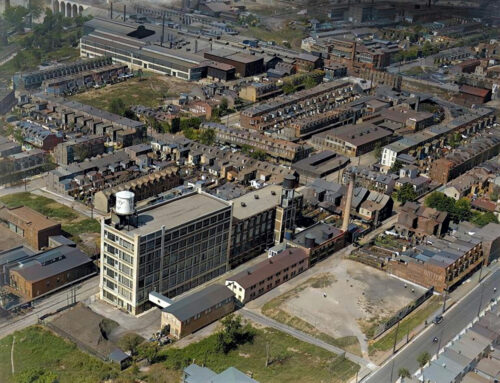
Formerly the Philadelphia & Reading Rail Mill. Two remodelings show that buying a mill and having a usable mill are different things. Idle for several years before 1938; assessed at about $250,000; scrapped 1939–40.
Charcoal Iron Plant
"Substituted" in 1923 for making charcoal-iron skelp for boiler tubes. A process change, not a construction date. Ran at intervals after the main plants closed; scrapped with the Ninth Street mill.

Colorized aerial photograph, GoReadingBerks collection.
Beyond Berks
Crumwold Furnace
Altered in late 1895 for a target of about 650 tons a week. Seller and price still unknown.
Montour Rolling Mills
Built 1845. Reading Iron bought the first-T-rail legend along with the mill. Dismantled for scrap by Luria Brothers in 1939–40.
Danville Puddle Mill
Bought and repaired early that year. Its exact relationship to Montour is an open question.
Pottstown Department
Puddle mill, nail plate mill, and nail factory with 105 machines, from the George B. Lessig Company.
Birdsboro Skelp & Nail Plate Mill
Seventy-five cut-nail machines, from the E. & G. Brooke Iron Company.
Columbia puddle and skelp mills
Formerly the Susquehanna Iron Company.
Somerset Coal Department
Bituminous steam coal from the company's own lands — 7,538 acres by Montgomery's count, 6,750 by Fox's.
Offices, and the Pennsylvania Steel question
The principal office was at 518 Washington Street in 1896. By 1937 the sales department sat in the Baer Building at 529 Court Street, with plant headquarters still at South Seventh. The company kept some fifteen branch sales offices around the country.
Montgomery reports that the company held "a large interest" in the Pennsylvania Steel Company. That is a shareholding, not a plant. No source gives the date, the number of shares, or what became of it — so it belongs in the financial history, not in this directory.
From a Somerset coal seam to a water main in Egypt
"Iron" hides a lot of distinct work. Here's the chain the company actually ran, and which plants sat at each link.
Fuel & ore
Bituminous coal from the company's own lands; ore and limestone purchased or quarried.
Somerset County · limestone quarryBlast furnace → pig iron
Ore smelted into pig and foundry iron.
Keystone · Crumwold · Furnaces No. 1 & 2Puddling → wrought iron
Pig iron refined in reverberatory furnaces, squeezed, rolled to muck bar.
Oley Street · Roe · Danville · Pottstown · ColumbiaRolling → skelp, bar, plate
Muck bar rolled into skelp, merchant bar, angles, plate, rails, beams.
South Street · Ninth Street · Montour · BirdsboroFinishing
Skelp welded into pipe and boiler tube; plate cut into nails; castings and forgings for machinery.
Tube Works · nail factories · Scott Foundry · ForgeEvery arrow above was a railcar. The plants were integrated on paper and by freight, never on one tract of land.
What "genuine puddled iron" meant
The company's later advertising leaned hard on that phrase, and it deserves a plain explanation. Puddling turned brittle pig iron into malleable wrought iron by hand. Pig was melted in a reverberatory furnace while a skilled puddler stirred the charge with a long iron rabble. As carbon and impurities burned out, the iron went pasty and gathered into balls. Those balls were squeezed to drive out slag, then rolled into rough "muck bar," which was reheated and rerolled into clean wrought iron for bar, plate, or skelp. It was hot, skilled, brutal work — and Reading kept doing it at a scale nobody else matched, deep into the age of steel.
What came out the other end
Wrought-iron pipe for gas, steam, and water, plain and galvanized — sold at the premium end as Reading 5-Point Pipe. Charcoal-iron and steel boiler tubes. Locomotive tubes. Oil-well casing and tubing. Hydraulic and line pipe, from an eighth of an inch to twenty inches. Skelp, muck bar, merchant bar, angle iron, boiler plate, rails, beams, channels. Cut nails by the tens of thousands of kegs. And out of the Scott Foundry and forge: cotton compressors, sugar-mill machinery, blast-furnace engines, tanks, boilers, ordnance, and marine forgings. During the First World War, Reading pipe carried water to British camps in Egypt.
Six thousand men and nine million dollars in wages
At its height the Reading Iron Company was one of the largest employers in Berks County. Montgomery's 1898 account counts 3,000 to 4,000 hands. The 1908 Annals give about 5,000. Fox's 1925 account says more than 6,000 men and roughly $9 million a year in wages, eighty percent of it paid out in Reading. The trades ran from puddlers, rollers, and heaters to molders, machinists, pipe welders, furnace men, crane operators, carpenters, and laborers.
The work was dangerous in ways the capacity tables never show.
In 1896 Michael Keef, 46, had worked at the Oley Street mill for two days when both his legs were crushed in a railroad accident at the plant. He underwent amputations at St. Joseph's Hospital and died of shock and blood loss.
Reading newspapers, 1896
Around the furnaces and mills grew the neighborhoods that housed those men, and the institutions they built for themselves. The Oley Street Mill Relief Association, with its clubhouse on North Front Street and sick and funeral benefits paid from weekly dues, is the one we can document. There were surely others.
The railroad's iron company
George F. Baer ran Reading Iron from 1889 to 1901 and then left to run the Philadelphia & Reading Railway itself, and for a while the two stories were told as if that were merely a coincidence of personnel. It was more than that. By the early twentieth century the Reading Company held a major block of Reading Iron stock — and that holding got caught in the federal antitrust case that broke up the Reading railroad and coal empire.
In 1922 the United States Supreme Court noted that Reading Company held $1 million par value of Reading Iron Company stock, worth substantially more than par, and questioned whether a reorganized railroad could lawfully go on owning an iron manufacturer. The 1923 reorganization that followed moved the Reading Iron holding out of the railroad and into the Philadelphia & Reading Coal & Iron corporate structure. That is what the Reading Times meant in 1937 when it wrote that control of Reading Iron had been "transferred in 1923" under the federal decree.
Leadership followed its own track. F. C. Smink succeeded Baer as president; in 1919 Smink became chairman and L. E. Thomas took the presidency. The 1924 officers were Thomas, J. M. Callen, James P. Roe, Henry N. Yost, and George W. Delany. By 1936 the president was P. N. Guthrie Jr.
Reported capacity, source by source
These are what the company and its chroniclers claimed the plants could make — capacities, not audited output — and they shift with the year and with what each writer decided to count. The 1936 column is different: those are actual reported results.
| Department | Montgomery, 1898 | Annals, 1908 | Fox, 1925 | Reported, 1936 |
|---|---|---|---|---|
| Tube works | 4 establishments · 75,000+ tons | 9 mills · 150,000 gross tons | 9 mills · 150,000 gross tons | 90,000 tons pipe, tube & muck bar handled |
| Blast furnaces | — | 2 · 180,000 gross tons | 2 · 175,000 gross tons | Keystone still listed |
| Rolling mills | 5 mills · 200,000 tons | — | 6 mills · ~200,000 gross tons | — |
| Nails | — | — | — | 52,000 kegs |
| Employees | 3,000–4,000 | ~5,000 | 6,000+ | ~2,200 |
| Payroll | — | — | ~$9 million | $2.4 million+ |
| Somerset coal lands | 7,538 acres | — | 6,750 acres | — |
The coal acreage shrinking could be a sale, a bookkeeping change, or a typo. We don't know, so we show both.
Still a giant at one hundred
This is the single most important correction the newspapers force on the old story. Reading Iron did not vanish in the first years of the Depression. At the close of 1936 — a century after Keim, Whitaker & Co. lit the first furnace — company president P. N. Guthrie Jr. reported the year's results for the Reading plants.
The same report called Reading Iron the world's largest manufacturer of genuine puddled iron and listed its Reading operations: the Tube Works and South Street Rolling Mill at South Seventh Street; the Oley Street Mills; the Charcoal Iron Plant and Ninth Street Rolling Mill at Ninth and Exeter; the Roe Puddling Department; and Keystone Furnace near West Greenwich Street. Sales were run from the Baer Building at 529 Court Street; plant headquarters remained at South Seventh.
Reading Times, February 1, 1937
Nearly fifty years after one financial collapse, and in the middle of another, the company was still employing 2,200 men and selling millions of dollars of iron. It had three months left.
How it actually ended: four years, plant by plant
The last pipe came off the mills at South Seventh Street in March 1937. Later that month the papers were still reporting the tube works as a going concern.
On March 31, 1937, an oil-spraying machine — used to coat finished pipe before shipment — ignited at the tube works at the foot of Seventh Street. Flames shot 50 to 75 feet in the air and damaged part of the roof before five companies, answering box 17 at Seventh and South, put it out.
Reading Times, March 31, 1937
Behind that ordinary fire story the company was already winding down. Its parent, the Philadelphia & Reading Coal & Iron Company, had filed for reorganization under Section 77B of the Bankruptcy Act on February 26 — a case built around more than $24 million in mortgage bonds. The tube works finished its last orders around June 1, 1937, and stopped. It had about 1,500 employees at the time. The Oley Street mills had run only occasionally that spring before closing for good; the Ninth Street rolling mill had been idle for years, with the charcoal plant operating at intervals. Only the nail plant at South Seventh kept regular hours.
Then came the disposition of assets, in three acts.
Act one: Scott Foundry finds a buyer (1938)
In November 1938 a Reading paper could still call the plant at Cedar and Buttonwood the "Scott foundry of the Reading Iron Company" — an acetylene torch had set part of the roof alight. But Birdsboro Steel Foundry & Machine Company's own records show that in 1938 Birdsboro bought the Scott Foundry from Reading Iron and ran it as a Reading branch of the Birdsboro concern.
Reading Times, November 16, 1938; Birdsboro Steel Foundry & Machine Co. archival records
Act two: "Reading Iron Mills Doomed" (December 1938)
On December 14, 1938, Building Inspector Alfred E. Eckenrode issued three permits to the company's chief engineer, Edward H. Leonard, to raze 85 buildings at the South Seventh Street pipe mills, the North Ninth Street mills, and the Oley Street mills. Keystone Furnace, near Oley Street, was already coming down under an earlier permit. The company budgeted $20,000 for the work; machinery would go to other plants or to scrap dealers. The Times called it the death of "an industry which 25 years ago employed more than 3,000 persons and made the name of this city famous the world over for iron pipe."
The numbers in that story are the best financial snapshot we have. Capital stock: $1,000,000. Peak investment in land and equipment: about $12,000,000. City assessments: about $500,000 for South Seventh, $250,000 for North Ninth, $200,000 for Oley Street "including the Roe puddler," roughly $1,400,000 with land, $1,500,000 for local tax purposes including Keystone. The Chamber of Commerce had tried to interest capital in restarting the mills — a new local company on a lease-sale plan, workers taking stock, a federal operating loan — and every proposal failed.
Reading Times, December 14, 1938, pp. 1, 12
Act three: the drive to save it (January 1939)
The permits set off the last fight. Protests poured into the office of R. E. Taggert, president of the parent coal company, from unions, businessmen, and civic groups.
Three plant superintendents — George D. Lain of the tube works, C. P. Bjorkbom of the Roe puddling plant, and Charles E. Morgan of the Oley Street mills — carried a petition signed by nearly 1,400 workers to Philadelphia asking that action be delayed until a plan could be found. A veterans' committee pointed out that more than 200 veterans worked at the mill. The Reading Company Employes' Booster Club wired on behalf of 3,800 railroad employees; Brotherhood of Railroad Trainmen lodges in Reading and Birdsboro, where the pig iron came from, warned of lost railroad jobs. George M. Rhodes of the Federated Trades Council and Luther H. Ammarell of the Reading Industrial Union Council telegraphed Senators James J. Davis and Joseph Guffey and Congressman Guy L. Moser. The Steel Workers Organizing Committee held contracts with the company.
The unions' argument was national: shutting Reading Iron or selling it to a competitor would hand the wrought-iron tube business to a monopoly at the very moment the government was building battleships and subsidized merchant ships — "virtually every battleship afloat today contains miles of Reading wrought iron pipe." Governor George H. Earle was asked to intervene, and the unions floated reviving Berks County's own low-grade iron ore, once worked at thirty furnaces and a hundred mines. In Pittsburgh, L. F. Rains of the A. M. Byers Company, Reading Iron's chief competitor, admitted his firm had inspected the plants but denied any plan to buy them. The Chamber's committee, chaired by R. L. Baker, waited on a consulting engineer's report on what the mills could be converted to make.
Reading Times, January 13, 1939, pp. 1, 10
Nothing came of it.
Scrap (1939–1940)
By July 11, 1940, Luria Brothers & Co., the country's largest scrap dealers, had bought and dismantled the Oley Street mill, the Roe puddling works, the Ninth Street mill and charcoal plant, and the Montour Rolling Mills at Danville. That day district manager Robert H. Clymer announced Luria's sixth purchase: the Seventh Street tube works, "last plant of the defunct Reading Iron Company, once Berks' biggest industry."
On November 1, 1940, Norristown powder experts Stephen J. Ryan and William Kreibel wedged thirty pounds of dynamite into the base of the 220-foot stack lettered READING IRON CO. — sixty feet around at the bottom — and dropped it. George L. Moore of Mt. Penn, superintendent at the plant for many years, stood in his overcoat and hat and watched the bricks go. Luria's crews were clearing buildings that covered four city blocks.
Reading Times, July 11, 1940; Reading Times, November 2, 1940, p. 9
The northwest tract went last. Site documentation records Keystone Furnace, the Roe Puddling Mills, and the Oley Street Mill as distinct Reading Iron operations and a 1941 sale of part of the property to Metropolitan Edison Company. One historic plant passed to a Berks County competitor and kept working; the rest became scrap, a utility site, and empty ground.
Twenty-five years earlier the company had employed more than 3,000 people. In the end, it took thirty pounds of dynamite and a scrap dealer.
Why it declined
The one-sentence version — they stuck with wrought iron, the world went to steel, the Depression finished them — is too easy. Reading Iron made steel boiler tubes, held a stake in Pennsylvania Steel, and kept a charcoal-iron line running for customers who wanted it. What it had, above all, was an enormous fixed plant spread across eight localities and rooted in a nineteenth-century process; a run of acquisitions in 1919 and 1920 made on the eve of the worst decade American industry ever saw; a corporate parent sinking under coal-company debt; and cyclical markets — railroads, oil, construction, municipal water — that all fell at once. The unions' own 1939 argument cuts both ways: if one competitor could absorb the whole wrought-iron tube trade, that trade had already shrunk to the size of one company. The integration that gave Reading Iron control over every stage of production also made it nearly impossible to shrink.
Luria's crews cleared four blocks at the foot of Seventh Street, and the Oley Street, Roe, Ninth Street, and Keystone plants all went for scrap. What's left is foundations, rail alignments, canal edges, and street patterns — and the Scott Foundry site, which kept working under Birdsboro Steel. That's a walk with a camera, not a claim from a book.
A hundred and five years, dated
- 1835180-hp engine built by McClurg, Wade & Co.Ordered for the founding works.
- 1836Keim, Whitaker & Co. open the Reading Iron and Nail WorksFoot of South Seventh, between the canal and the railroad.
- 1846Firm becomes Seyfert, McManus & Co.
- 1848First pipe millStart of the Tube Works lineage.
- 1850Steam Forge built
- 1853Furnace No. 1
- 1850sScott Foundry establishedCivil War ordnance follows.
- Apr 7, 1862Act incorporating "the parties doing business at the Reading iron works" as Seyfert, McManus & CompanyConfirmed by the 1868 House proceedings. Scott Foundry and Forge join the works about this time.
- 1865Sheet Mill
- c. 1866Firm organizes under the 1862 charter"Incorporated some two years ago," per the 1868 debate; a partner's death prompted it.
- Mar 1868House Bill 760 passes, 49–8Rights to lay water pipes through Reading's streets and draw on outside springs; banking privileges expressly excluded.
- 1874Furnace No. 2
- Sept 1875Hexamer insurance surveys map three plantsFurnaces at South St. and the P&R; Steam Forge at N. Eighth and Hockley Lane; Sheet Mill at S. Water, Chestnut, Spruce and the canal. Owner still Seyfert, McManus & Co.
- 1878Corporate name changed to Reading Iron Works (per Fox)A renaming of the 1862 corporation, not a new charter.
- Mar 1889Reading Iron Works suspends operationsAssets reportedly $500,000 over liabilities; no working capital. P&R help discussed, not given.
- Aug 1889Assignee's sale; Smink buys nearly everythingInventory covers Tube Works, Rolling Mill, furnaces, Sheet Mill, Forge, Scott Foundry.
- Aug 12, 1889Reading Iron Company organizedBaer president. Buys the plants from the assignee.
- Aug 22, 1889Keystone Furnace Co. assigns for creditorsTwo furnaces, ~13 acres.
- Aug 29, 1889Whistle tested at the Scott Works, Eighth & ButtonwoodRestart preparations across the works.
- Sept 1889Baer buys Keystone for $100 over encumbrances$175,000 Reading Trust mortgage plus interest; ~10 acres; Fleetwood tract.
- 1895Montour Rolling Mills, Danville, acquired
- Sept 1895Oley Street Mills under constructionGas furnaces, grateless water-seal producers.
- Nov 1895Crumwold Furnace, Emaus, being alteredTarget ~650 tons/week.
- Oct 1896Oley Street puddling department resumes, ~200 men
- 1896Ninth Street Rolling Mill addedFormerly the P&R Rail Mill.
- Dec 1896Baer and Harris inspect the "new plant at Oley street"Office at 518 Washington St.
- 1899Ninth Street mill remodeled
- 1901Montour rebuilt; Baer leaves for the railroad; Smink president
- 1901–02New forge on North Ninth Street
- 1902Ninth Street mill remodeled again
- 1905Danville Puddle Mill purchased and repaired
- 1905–06Scott Foundry rebuilt
- 1919L. E. Thomas president; Smink chairman
- 1919Pottstown Department acquired from George B. Lessig Co.
- 1920Birdsboro mill (E. & G. Brooke) and Columbia mills (Susquehanna Iron) acquired
- 1922U.S. Supreme Court notes Reading Co.'s $1M par holding in Reading Iron
- 1923Control transferred to the P&R Coal & Iron structure under the federal decree
- 1923Charcoal Iron Plant substituted at Ninth and Exeter
- 1924Officers: Thomas, Callen, Roe, Yost, Delany
- c. 1926Passing Scene geographic snapshot
- 1936$3.7M sales · 90,000 tons · 52,000 kegs · 2,200 men · $2.4M payrollReported Feb 1, 1937; P. N. Guthrie Jr. president.
- Feb 26, 1937P&R Coal & Iron files under Section 77B$24M+ in bonds. Parent, not the iron company itself.
- Mar 1937Last pipe rolled at South Seventh StreetOil-spraying machine fire at the tube works, March 31.
- c. Jun 1, 1937Tube works finishes its last work and stopsAbout 1,500 employees at the time.
- 1938Scott Foundry sold to Birdsboro Steel Foundry & MachineStill called "of the Reading Iron Company" in a Nov. 16 roof-fire report.
- Dec 14, 1938Permits to raze 85 buildings at South Seventh, North Ninth, and Oley StreetKeystone already coming down. Chamber of Commerce rescue plans had failed.
- Jan 1939Petition of ~1,400 workers; unions, veterans, and railroad men appeal to Harrisburg and WashingtonA. M. Byers Co. denies plans to buy the plants.
- 1939–40Luria Brothers scraps Oley Street, Roe, Ninth Street and charcoal plant, and Montour
- Jul 11, 1940Seventh Street tube works, "last plant of the defunct Reading Iron Company," sold to Luria for scrap
- Nov 1, 1940The 220-foot stack comes downThirty pounds of dynamite; four city blocks being cleared.
- 1941Part of the northwest tract sold to Metropolitan EdisonKeystone, Roe, and Oley Street operations recorded on the site.
Same thing, or not?
A century of renaming, rebuilding, and photo captions has tangled the vocabulary. Here's how to untangle it.
The 1836 works, the incorporated predecessor, and the 1889 reorganized corporation. One nucleus, three eras.
The Tube Works grew out of the original installation; "Main Works" is a later label for the same ground.
"Scott Works" is 1889 newspaper shorthand. The Eighth-and-Buttonwood and Cedar-and-Buttonwood addresses likely describe different frontages of one large property.
The railroad's rail mill became Reading Iron's rolling mill in 1896.
Locally associated with the Bushong name before the 1889 assignment.
Older and modern spellings of the Lehigh County borough where Crumwold stood.
Keystone is in northwest Reading. Crumwold is in Emaus.
Nos. 1 and 2 belonged to the pre-1889 works at the south end.
Don't date the 1902 building to 1850.
The 1937 bankruptcy filing was the parent's. Reading Iron was still producing that month.
Each had its own superintendent in 1939 and Luria scrapped them as separate purchases, but the city assessed them together as "Oley street mills, including the Roe puddler."
Probably a department of the main works, but the sources don't say whether it was its own parcel.
Both in Danville, bought ten years apart. Adjoining? Associated? The wording doesn't prove either.
Where this comes from
Histories and site memory
- Description of the Borough of Reading, pp. 45–49; reprinted in the Reading Times, April 18, 1867, p. 1. Early description of the founding works — buildings, machinery, fuel, output.
- Morton L. Montgomery, History of Reading, Pennsylvania, 1748 to 1898, pp. 186–187.
- Cyrus T. Fox, Reading and Berks County, Pennsylvania: A History (1925), pp. 470–472.
- Historical and Biographical Annals of Berks County (1909), pp. 224–226.
- The Passing Scene, Vol. 14, pp. 53–54; Vol. 24, p. 34. Keystone/Oley Street caption; the 1926 departmental geography.
- Iron Industries in Reading, Pennsylvania, berks.pagenweb.org — 1909-era capacity figures.
- American Iron and Steel Association directory — trade-directory lead; edition citation still to be verified.
- Hexamer General Surveys, Vol. 10, plates 933–938, Free Library of Philadelphia — 1875 fire-insurance surveys of the Rolling Mill and Tube Works, Scott Foundry, Furnaces, Steam Forge, and Sheet Mill, owner Seyfert, McManus & Co.
- Historical Society of Pennsylvania, Campbell Collection v. 28, p. 141. 1866 lithograph of the Seyfert, McManus & Co. Reading Iron Works, factories and offices.
- Reading Iron Company: The Rise and Fall of an Industrial Giant, GoReadingBerks — the earlier overview this article expands on.
Newspapers
- Reading Times, March 20, 1868, p. 2. Pennsylvania House proceedings on House Bill 760, citing the April 7, 1862 act incorporating the Reading Iron Works; water rights and the banking-privileges debate.
- Reading Times, March 7, 1889, p. 1; March 12, 1889, p. 2. Suspension; the debate over Pennsylvania iron.
- Reading Times, August 1, 1889, p. 4; August 7, 1889, p. 4. Assignee's sale advertisements and results.
- Reading Times, August 22, 1889, p. 1. Keystone Furnace Co. assignment.
- Reading Times, August 29, 1889, p. 1. Restart preparations; the Scott Works whistle.
- Philadelphia Inquirer, September 20, 1889, p. 2. Baer's purchase of Keystone.
- Scranton Tribune, September 2, 1895, p. 6. Oley Street under construction.
- Patriot-News (Harrisburg), November 4, 1895. Crumwold alterations.
- Argyle Atlas, October 16, 1896. Oley Street puddling resumes.
- Reading Times, December 23, 1896, p. 2. Baer–Harris inspection; 518 Washington Street office.
- Reading Times, February 1, 1937, p. 15. 1936 results, plant list, 1923 transfer.
- Reading Times, March 31, 1937. Oil-spraying machine fire at the tube works.
- Reading Times, November 16, 1938, p. 11. Scott Foundry roof fire, Cedar and Buttonwood.
- Reading Times, December 14, 1938, pp. 1, 12. "Reading Iron Mills Doomed" — razing permits, assessments, closing sequence, failed rescue plans.
- Reading Times, January 13, 1939, pp. 1, 10. "Reading Iron Drive Grows" — the campaign against liquidation.
- Reading Times, July 11, 1940. Tube works sold to Luria Brothers; other plants already scrapped.
- Reading Times, November 2, 1940, p. 9. "Reading Landmark Bites the Dust" — demolition of the stack.
Legal, corporate, and site records
- U.S. Supreme Court, 1922 Reading Company antitrust decision. The $1 million par Reading Iron holding.
- Reading Company financial records, 1923 reorganization. Transfer of the Reading Iron stock.
- Philadelphia & Reading Coal & Iron Co. Section 77B filing, February 26, 1937.
- Birdsboro Steel Foundry & Machine Co. archival records. 1938 purchase of the Scott Foundry.
- Environmental/historical site documentation, northwest Reading industrial tract. Keystone, Roe, Oley Street operations; 1941 Metropolitan Edison sale.


Leave A Comment