
Site Update · Books Search
Sixty-Eight Books. One Search Box.
The GoReadingBerks Books collection now searches as one — turning a shelf of local history into a single, connected index.
Search the Books Collection →Every local historian eventually ends up with the same problem: the answer is probably sitting on a bookshelf somewhere, but finding it can take hours.
One book might contain a passing reference to a family name. Another might mention a long-forgotten business. A church anniversary booklet may hold the only surviving description of a neighborhood event, while a county history published decades earlier provides the missing context.
The information is there. The problem has always been finding it.
Among the 68 books now included in the GoReadingBerks Books collection are works such as Morton L. Montgomery's School History of Berks County, David B. Brunner's writings on the Indians of Berks County, church histories, anniversary publications, local histories, and other books that were never designed to be searched together.
Until now, researching across the collection meant opening one book after another and hoping you happened to look in the right place.
We replaced that process with a search box.
One search can now look across all 68 books at once.
From a Bookshelf to a Searchable Collection
Sixty-eight books may fit on a few shelves, but together they contain thousands of pages of Berks County history.
Within those pages are family names, businesses, churches, industries, streets, communities, historic events, biographies, organizations, and countless small details that may appear only once in an otherwise unrelated publication.
That is what makes collections like this so valuable — and also so difficult to research.
A person looking for a particular surname might have no reason to suspect that it appears in a church history. Someone researching an old Reading business might never think to check a borough anniversary booklet. A street name could appear in several books published decades apart.
The new search system makes those connections easier to discover.
Search a family name, and the system can show which books contain it. Search a business, church, neighborhood, street, organization, or historic figure, and results can appear from across the entire collection.
Instead of deciding which book to open first, researchers can begin with the subject they are actually interested in.
Building on What Already Worked
The Books Search did not begin from scratch.
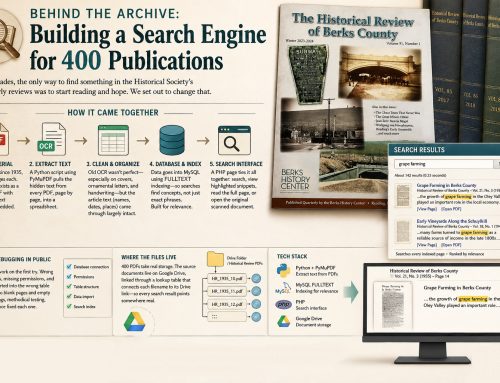
- Earlier this month, GoReadingBerks built a full-text search system for roughly 400 issues of The Historical Review of Berks County.
- That was followed by a searchable collection of George M. Meiser IX's 25-volume The Passing Scene
- Now the 68-book collection joins them, built on the same tested pipeline.
The scanned publications already contained OCR — optical character recognition — text hidden behind the images of the original pages. A Python script could extract that text, separate it by page, and prepare it for a searchable database.
Each book goes through essentially the same process whether it contains 40 pages or 400. The text is extracted page by page. Each page is associated with the title of the book, its page number, and the original source document. That information is then loaded into a MySQL database.
The result is no longer 68 isolated files. From the search engine's perspective, they become one large collection.
Finding the Most Useful Results
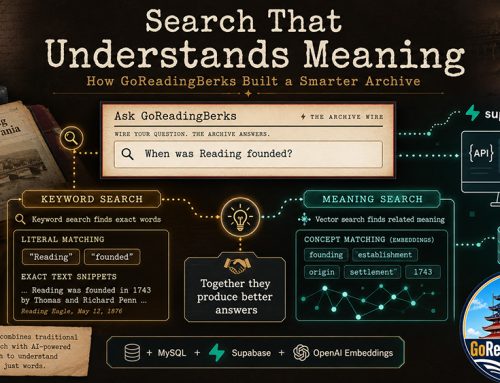
The database uses full-text indexing rather than simply scanning every page for an exact sequence of characters. That means the search can rank matching pages by relevance, helping bring the strongest results toward the top.
If a name or subject appears repeatedly on one page and only briefly on another, the more relevant page may appear higher in the results.
The goal is not simply to say, "These pages contain your search term." It is to help answer the more useful question: Where should I start reading?
Each result also identifies the book and page associated with the match, allowing researchers to move from the search result back to the original publication. The books remain the historical source. The search engine simply provides the index that the collection never had.
Sixty-Eight Books, One Search Box
A collection of individual books presented another challenge. The earlier search projects focused largely on publications that belonged to a single series. The Books Search contains unrelated titles covering different subjects, authors, communities, and periods.
Researchers therefore needed a way to see what was actually available before searching it. When someone visits the Books Search without entering a search term, the page displays the entire collection — every available title pulled directly from the database, along with its page count and a link to the original book.
The result works a little like a digital bookshelf. You can browse the titles if you know what book interests you, or ignore the shelf entirely and search across everything at once.
Giving the Books Their Own Room
Rather than adding the collection as another option inside an existing search page, the books received their own dedicated section of GoReadingBerks. The /books/ section combines the search interface and the complete title list in one place.
It is a small design decision, but an important one. A collection of dozens of independent books should feel like a collection in its own right — something a researcher can browse, search, and return to — rather than a feature buried inside another archive.
In that sense, the page functions as both a search engine and a digital card catalog. Except this card catalog can search inside the books.
The Parts Nobody Sees
There is also a less visible side to building something like this. The website needs searchable text, but it does not necessarily need to store dozens of large PDF files on the same web server.
The original documents can remain in Google Drive while the database stores the searchable text and the links necessary to reach each book. A script can collect the document links and associate them with the correct titles in the database.
That keeps the search system relatively lightweight while still giving researchers a direct path back to the source material.
There is also the work that has nothing to do with the search algorithm itself: page titles, descriptions for search engines, social-media preview information, and the visual design that helps visitors understand what the collection represents. Those details are easy to overlook, but they are part of turning a technical experiment into something people can actually use.
OCR Isn't Perfect — and That's Okay
Historic documents present another challenge. OCR is remarkably useful, but it is not flawless. Older typefaces, faded printing, damaged pages, unusual names, tightly spaced columns, and imperfections in scanned pages can all cause words to be misread.
That means a missing search result does not necessarily prove that a name or phrase never appears in the collection. The search should be treated as a research tool rather than an infallible index.
But even with those limitations, the difference is enormous. Instead of manually inspecting thousands of pages across 68 books, a researcher can search the entire collection in seconds and immediately identify promising places to investigate.
The search does not replace careful historical research. It gives that research a much better starting point.
Something Larger Is Taking Shape
The most interesting part of this project may not be the 68 books themselves. It is what happens when this collection is viewed alongside the other searchable archives that have already been built.
First came hundreds of issues of The Historical Review of Berks County. Then came the 25 volumes of The Passing Scene. Now another 68 books can be searched.
What began as a way to make one publication easier to research is gradually becoming something larger: a searchable layer across collections of Berks County history that were never created to work together.
Each new collection increases the possibility of discovering connections between sources. A family mentioned in a county history may appear decades later in a local publication. A company discussed in one book may turn up in a neighborhood history. A name that once required hours of searching may suddenly appear in sources a researcher never would have thought to check.
That is where this technology becomes useful to local history. Not because the technology itself is particularly complicated. At its core, the system is still a script, a database, and a web page. What matters is what those pieces make possible.
A search that once meant pulling 68 books from a shelf, checking indexes when they existed, and turning hundreds or thousands of pages can now begin with typing a few words.
The books themselves remain the source. The search engine is simply the index they never had — a way to discover which book deserves to be opened.



Leave A Comment