North Thirteenth Street, Reading, Pennsylvania
Selwyn Hall
The Deininger estate, the military academy, and the ground that became Albright College
- 1835E. Jonathan Deininger builds his mansion on a country estate
- 1854Gold reported in quartz taken from the farm
- 1869A 600-acre estate settled for $60,000
- 1870National Guard encampment on Deininger’s Farm
- 1871Residents propose buying the estate for a public park
- 1872David P. Lash opens a hotel and pleasure resort
- 1875Episcopal Diocesan School for Boys
- 1883Selwyn Hall
- 1902Schuylkill Seminary, later Schuylkill College
- 1929Albright College
Long before Albright College occupied the hillside of northeast Reading, the property around North Thirteenth Street was part of a sprawling country estate overlooking the growing city. At its center stood the mansion of E. Jonathan Deininger, a German-born landowner, agriculturalist and horticulturalist whose property once encompassed hundreds of acres on Reading’s northeastern edge.
During the nineteenth century, the estate would host soldiers, attract proposals for a public park, become a pleasure resort, and eventually be transformed into an Episcopal preparatory school for boys known as Selwyn Hall. After Selwyn Hall closed, another educational institution took over the property. Schuylkill Seminary returned to Reading, became Schuylkill College, and ultimately merged with Albright College.
The modern Albright campus therefore stands on ground whose educational history reaches back decades before Albright itself arrived in Reading. But the story begins with the man whose name was attached to the land.
The man and the land
1801 to 18721801
Who was E. Jonathan Deininger?
Born Württemberg, September 10, 1801. Died Reading, August 1881.
E. Jonathan Deininger was born September 10, 1801, in Württemberg, Germany. His father, Christian Deininger, was a schoolteacher and organist. When Jonathan was about eighteen years old, the family emigrated to the United States. Christian Deininger initially settled in Germantown, Pennsylvania, where he accepted a position as organist and schoolmaster with Trinity Lutheran congregation. He later moved to Reading.
Jonathan followed a different path. In the spring of 1834, he married Mary E. H. Muhlenberg, daughter of Henry A. Muhlenberg, one of Reading’s most prominent nineteenth-century citizens. Henry Muhlenberg served in Congress, was appointed United States minister to Austria, and later became a candidate for governor of Pennsylvania. The marriage connected Deininger with one of Pennsylvania’s best-known political and religious families.
Jonathan and Mary established their home on a large farm northeast of Reading, then outside the developed city and within Muhlenberg Township. There Deininger erected the mansion that later became the center of the Selwyn Hall property.
1835
A country estate outside Reading
When the Deininger mansion was built in the mid-1830s, northeastern Reading looked nothing like it does today. The city had not yet spread far into the surrounding countryside. The Deininger residence stood amid fields, woodland, springs and agricultural buildings near the foot of Mount Penn. Later descriptions remembered the property for its attractive location, plentiful water, mature trees and broad open spaces.
Although the immediate mansion grounds later associated with Selwyn Hall consisted of only several acres, Deininger’s overall landholdings were far larger. By 1869, contemporary accounts described the Deininger estate as containing approximately 600 acres, including the mansion house and other improvements. That means the future Selwyn Hall campus represented only a small portion of a much larger property extending through what was then the northeastern outskirts of Reading.
1838
Mary Deininger and the Muhlenberg estate
Jonathan Deininger’s ownership of much of this property came through his wife. Mary Elizabeth Muhlenberg was connected to the estate of former Pennsylvania governor Joseph Hiester, who died in 1832 without a will. Mary inherited an interest in the Hiester property.
When she died childless in 1838, she attempted to leave her property to her husband. Jonathan continued to possess, develop and lease those lands for decades. But the legal status of the property would eventually become far more complicated than anyone expected.
1868
George F. Baer and the Deininger property case
In 1868, a young Reading attorney named George Frederick Baer was asked to examine the title to some Reading real estate connected with Deininger. Baer discovered a serious problem. Mary Deininger’s will had been written before changes in Pennsylvania law governing married women’s property. Under the older law, her attempt to leave the property outright to her husband was legally defective.
Jonathan Deininger therefore did not have complete ownership of all the property he had long believed was his. Instead, he held what amounted to a life interest, with ultimate ownership belonging to Mary’s heirs. The dispute became even more serious because Deininger had cut timber from portions of the property. A person holding only a life estate generally could not permanently diminish the value of property belonging ultimately to someone else.
A settlement followed. In 1869, Deininger’s life interest in the property was transferred to the heirs in exchange for $60,000. Contemporary reporting described the estate involved in the transaction as approximately 600 acres, including the mansion house and other improvements.
For George F. Baer, the case proved enormously important. His ability to recognize a title problem that others had overlooked helped establish his reputation as a Reading lawyer. Baer reportedly received a $5,000 legal fee, a substantial sum at the time. He would later become one of the most powerful figures in the American railroad and anthracite industries and eventually president of the Philadelphia & Reading. One of the cases that helped launch that career began with Jonathan Deininger’s Reading real estate.
1854
Gold on Deininger’s farm?
The Deininger property even briefly attracted attention for something considerably more unusual.
A geologist, a quartz sample and a very small strike
In 1854, newspapers reported that an English geologist conducting mineralogical research in Berks County had examined quartz rock from E. Jonathan Deininger’s farm, a mile or two northeast of Reading. Small specimens of gold were reportedly found in the quartz. The discovery was described enthusiastically, with the gold said to appear remarkably pure.
There is no evidence that Deininger’s farm ever became a meaningful gold-mining operation, but the report offers another glimpse of just how rural and undeveloped the area remained during the middle of the nineteenth century. Before there were classrooms, dormitories and college buildings, people were examining rocks from the property for gold.
1840s–60s
Deininger the agriculturalist
After the death of his wife in 1838, Deininger devoted much of his attention to his property. Agriculture and horticulture became major interests. He was active in the Berks County Agricultural and Horticultural Society and was among its early life members. He worked to improve his farm and manage his estate while also maintaining a strong interest in books and study.
Contemporary descriptions remembered him as well informed, widely read, conversational and personally unassuming. He was also a member of St. John’s German Lutheran congregation in Reading. Deininger eventually left the farm and later lived in the city, but the northeastern estate continued to carry his name.
1870
Soldiers at Deininger’s farm
By the summer of 1870, the property was being used for large public gatherings. The 3rd Regiment National Guards of Philadelphia arranged an encampment at Deininger’s Farm from August 6 through August 13. The event was large enough that concession rights were advertised for an ice cream stand, an eating stand, a watermelon and fruit stand, a cigar stand, and a peanut and cake stand.
The episode offers an interesting preview of the property’s later educational use. Several years before uniformed school cadets marched across the estate, National Guardsmen were already camping there.
1871
Reading almost turned the estate into a public park
The following year, the future of the land became the subject of a public debate. In August 1871, a Reading resident urged city officials to purchase the Deininger estate and preserve it as a public park. The proposal provides one of the best contemporary descriptions of the property before northeast Reading became heavily developed.
The estate was described as a magnificent farm in the path of the city’s expansion. The writer warned that Reading was rapidly spreading northeastward and predicted that within ten or fifteen years the land might be divided into building lots. The property was praised for being beautifully situated, heavily wooded in places and crossed by two streams of pure spring water. The writer argued that few places near Reading possessed comparable natural advantages for a park.
The city did not acquire the land.
Had it done so, one of Reading’s largest nineteenth-century parks might today occupy the ground where Albright College eventually developed.
1872
David P. Lash buys the mansion
Instead, the property entered another chapter. In 1872, David P. Lash purchased the Deininger mansion and approximately three acres of surrounding ground for $12,000. Lash intended to turn the estate into a hotel and pleasure resort.
The same features that had inspired the public-park proposal made the property ideal for recreation: scenery, trees, spring water, open grounds and convenient access from the city by carriage. Lash began improving the property and envisioned a hostelry comparable to other popular resorts around Reading. The Deininger mansion was expected to attract the city’s “pleasure-seekers.” For a brief period, the old country estate became a recreational destination.
The academy
1874 to 18951874
Reading competes for an Episcopal school
By 1874, a new possibility emerged. The Episcopal Diocese of Central Pennsylvania was searching for a permanent location for a proposed Diocesan School for Boys. Reading faced competition. Potential sites were considered in York, Lancaster and Columbia.
Supporters in Reading, however, made a determined effort to secure the institution. A diocesan committee inspected several properties in and around the city, including the former Deininger estate. The mansion and grounds ultimately proved attractive enough to win the school for Reading.
1874
The Episcopal Diocese acquires the property
The Episcopal authorities acquired the Deininger property from David P. Lash during 1874. Contemporary accounts described a purchase involving approximately three acres and a price around $14,000, while later accounts gave the property as closer to 4½ acres and the price as $14,800. The difference likely reflects variations in how the parcel and associated improvements were described.
Regardless, the former Deininger mansion was about to undergo another dramatic transformation. It would become a school.
1875
Turning a country mansion into a boarding school
The residence required considerable alteration. Rooms originally designed for family life had to be converted for classrooms, boarding accommodations and institutional use. Furniture and educational equipment were installed. The surrounding grounds were prepared for students.
The school’s founders envisioned more than simple classroom instruction. They emphasized scholarship, religious training, discipline, physical development and character. Their goal was to provide families throughout Central Pennsylvania with a strong preparatory school without forcing them to send their sons far from home.
1875
The Diocesan School for Boys opens
Students began arriving in September 1875. The formal opening followed on October 7, 1875. Residents of Reading were invited to inspect the building and see how the old Deininger mansion had been transformed. Within only a few years, the same property had been a country residence, a proposed public park, a pleasure resort, and now a residential school.
By 1877, the Diocesan School for Boys was entering its third year. Rev. Joseph M. Turner served as headmaster, and the institution emphasized both scholarship and Christian character.
1881
The death of Jonathan Deininger
Jonathan Deininger lived long enough to see his former country home transformed into a school. He died in August 1881, shortly before his eightieth birthday. His obituary recalled the beautiful farm in the northeastern section of Reading where he and his wife had lived and specifically noted that the Diocesan School for Boys was then located there. It also remembered Deininger as the man who had erected the mansion and lived in it for many years.
His wife Mary had died more than four decades earlier, in 1838. Their two children had died in infancy. Deininger spent his later years devoted to agriculture, horticulture, books and the management of his affairs. He was buried in the Charles Evans Cemetery. By the time of his death, the estate that had defined a large part of his adult life was already entering an entirely different era.
1882
Howe Hall and the future White Chapel
The school continued to expand. In 1882, a one-story brick building called Howe Hall was erected in honor of Bishop M. A. DeWolfe Howe. A second story was added six years later.
Howe Hall eventually became one of the most recognizable structures on the later Albright College campus: White Chapel. It was a separate building from the original Deininger mansion and represented the growing institutional character of the property.
1883
Selwyn Hall
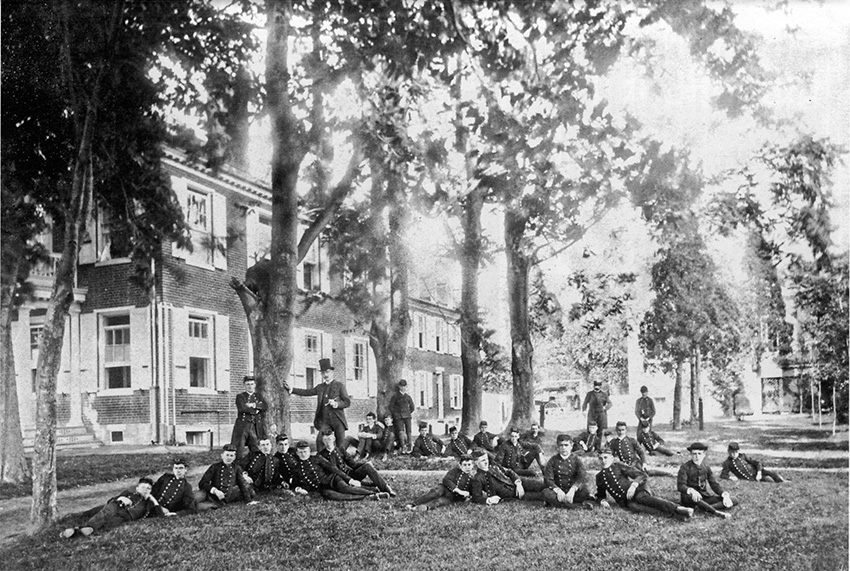
By 1883, the Episcopal school was known as Selwyn Hall. Advertisements described it as “A Military, Boarding and Day School for Boys.” The name became closely associated with the school and its campus.
Selwyn Hall accepted both boarding and day students and prepared boys for universities, West Point, Annapolis and business careers. Military organization became one of its most visible features. Cadets wore uniforms, participated in drill and lived under a structured system of discipline. Historic photographs show the young men in front of the old Deininger mansion and relaxing beneath enormous trees across the grounds.
1883
Lot Clarke Bishop and the expansion of Selwyn Hall
Lot Clarke Bishop became headmaster in 1883 and later carried the title Head Master and Commandant of Cadets. His tenure coincided with a period of expansion. The school buildings were improved to accommodate additional students, while academic standards were strengthened. Selwyn Hall sought to prepare its pupils not only for military academies but for colleges, universities and scientific institutions.
1880s
More than a military academy
Despite its military appearance, Selwyn Hall was fundamentally a preparatory school. Its students studied subjects including classical languages, mathematics, science, English, German, sacred history, music and French. The school employed teachers, matrons, a chaplain and a physician.
Military drill formed an important part of school life, but academics remained central. Graduates later attended institutions including Lehigh, Princeton and Yale, while others continued into military education at West Point.
1885
Selwyn Hall’s great day
By 1885, Selwyn Hall was well established. Its commencement celebration that year included chapel services, academic examinations, prizes, speeches, cadet drill and music supplied by Reading’s Liberty Cornet Band. Students were examined in subjects including Latin and geometry. Twenty-six pupils were enrolled in the various classes.
The 1884–85 school year was particularly encouraging financially because the institution reportedly covered its expenses entirely through income for the first time. The achievement was significant for a school that would continue to struggle with finances.
1880s
Learning beyond Reading
Selwyn Hall students also traveled beyond the campus as part of their education. Excursions were planned to Lehigh University at South Bethlehem, the Philadelphia Zoological Garden, Gettysburg and the Switchback Railway at Mauch Chunk. These trips exposed students to higher education, natural science, history and engineering.
1890s
A small school with ambitions
Selwyn Hall never became a large institution. Near the end of its existence, enrollment was reported as averaging about 30 pupils. During Lot Clarke Bishop’s tenure, the highest reported enrollment was 38 students in one year.
The small size created a close residential environment where students lived, studied and trained together. Despite its limited enrollment, Selwyn Hall established a reputation extending beyond Reading.
1894
The final years
By the mid-1890s, the school was facing serious difficulties. The headmaster, Rev. Mr. Wilke, resigned in June 1894. The trustees subsequently leased the buildings to Dr. Samuel W. Murphy of North Carolina, who attempted to continue the academy. The fall term opened with only 18 students and four faculty members.
Murphy’s health soon deteriorated. Unable to give the institution sufficient attention, he left Reading hoping to recover while two teachers temporarily maintained the school. Soon afterward, the students were informed that the academy would close. Some immediately packed their trunks and left.
1895
Selwyn Hall closes
In February 1895, Selwyn Hall closed. Its four-year curriculum included classical, scientific, mathematical and English courses. Although students wore uniforms and participated in military exercises, contemporary descriptions stressed that the institution was primarily a preparatory school rather than simply a military academy.
At the time of the closing, the property was valued at approximately $25,000. The Episcopal school was gone. The Selwyn Hall name remained.
The seminary
1895 to 19281901
An empty campus
For several years the former school property stood largely idle. By 1901, Selwyn Hall was being advertised for sale. The property was described as approximately four acres with roomy buildings, a complete gymnasium, pure running water and city conveniences. One advertisement even suggested that it would make an excellent sanitarium.
By this point, the site had developed far beyond Jonathan Deininger’s original mansion. It had become a small institutional campus.
1902
Selwyn Hall is sold
In 1902, Walter G. Boas and Isaac Spatz purchased the Selwyn Hall property for $7,500. Their intention was to make it available for Schuylkill Seminary. The property was described as approximately 4.14 acres with five buildings, including a gymnasium, chapel, dormitories and other school facilities. The campus was reportedly capable of accommodating as many as approximately 160 people.
The old school grounds were about to become an educational institution once again.
Four transactions on the same ground
- 1869
- Deininger’s life interest in roughly 600 acres transferred to Mary’s heirs
- $60,000
- 1872
- The mansion and about three acres, sold to David P. Lash
- $12,000
- 1874
- Lash sells to the Episcopal Diocese of Central Pennsylvania
- $14,000–$14,800
- 1902
- Trustees sell 4.14 acres and five buildings to Walter G. Boas and Isaac Spatz
- $7,500
At its closing in 1895 the campus had been valued at roughly $25,000. Seven years of idleness cost the ground two thirds of its worth.
1881
Schuylkill Seminary returns to Reading
Schuylkill Seminary already had a history of its own. The institution had been established in Reading in 1881 by the East Pennsylvania Conference of the Evangelical Association. In 1886, it moved to Fredericksburg in Lebanon County, where it remained for roughly sixteen years.
By 1902, church leaders wanted to bring the school back to Reading. The former Selwyn Hall campus offered a ready-made location.
1902
Reading helps bring the school back
The move required substantial financial assistance. Supporters sought $12,500 in local subscriptions to help acquire, renovate and equip the property. The total cost of the project was estimated at approximately $25,000.
Supporters argued that Schuylkill Seminary would benefit Reading not only educationally but economically. The institution was expected to generate approximately $20,000 a year in local spending. The seminary then had about 60 students in Fredericksburg, and supporters hoped enrollment would increase considerably after the return to Reading.
1902
Schuylkill Seminary opens at Selwyn Hall
During the summer of 1902, the East Pennsylvania Conference approved the transfer. In September 1902, Schuylkill Seminary opened at Selwyn Hall under Rev. Warren F. Teel, Ph.M. Its curriculum included classical studies, Latin scientific, English scientific, academic courses, commercial education, music, elocution, voice culture and theology. The old Deininger property had begun another educational life.
1902
A final reminder of the old farm
Despite the development around it, remnants of Jonathan Deininger’s agricultural estate remained. In December 1902, a large stone-and-brick barn near the seminary was destroyed by fire. The structure measured approximately 40 by 120 feet and had been erected by Jonathan Deininger many years earlier.
Twenty-three cattle had fortunately been moved to pasture that morning. Approximately 50 tons of hay and three tons of straw, however, were destroyed. Even as a college campus emerged, parts of the old farm were still present.
1914
Howe Hall becomes White Chapel
Howe Hall continued to evolve under Schuylkill Seminary. It became commonly known simply as “the chapel.” In 1914, a senior class donated a clock and bell tower. The clock came from the Howard Clock Company of New York, while the bell was manufactured by the Meneely Bell Company of Troy, New York.
The building was later enlarged and fitted with stained-glass windows. It survived fires in 1932 and 1944. By about 1956, it was generally known as White Chapel.

2015
White Chapel’s many lives
White Chapel eventually served many purposes. At different times it functioned as a chapel, dormitory, science laboratory and art department facility. Students and faculty successfully opposed an attempt to demolish it during the late 1970s.
After the art department moved out in 1990, however, the building became largely vacant and was primarily used for storage. A structural study completed in 2012 found serious deficiencies. In 2015, the approximately 133-year-old building was demolished. One of the last major physical reminders of the nineteenth-century Selwyn Hall campus had disappeared.
The college
1923 onward1923
Schuylkill Seminary becomes Schuylkill College
Schuylkill Seminary continued to expand after returning to Reading. In 1923, the institution became Schuylkill College. That distinction is important when looking at photographs of the present campus from the 1920s. A photograph taken there in 1925 shows Schuylkill College, not Albright College. Albright had not yet moved to Reading.
1856
Albright College had its own history
The institution that became Albright College developed separately. Modern Albright traces its ancestry to Union Seminary, established in New Berlin, Pennsylvania, in 1856 by the Evangelical Association. Union Seminary became Central Pennsylvania College in 1887. A separate denominational branch later established the Albright Collegiate Institute in Myerstown in 1895. That institution became Albright College in 1898.
By the early twentieth century there were therefore two separate schools: Albright College in Myerstown and Schuylkill Seminary in Reading. Central Pennsylvania College, descended from the original Union Seminary, merged with the Myerstown Albright institution in 1902. This institutional lineage explains why modern Albright College traces its founding to 1856.
1928
Albright comes to Reading
The church divisions that had contributed to the development of separate institutions eventually healed. In 1922, the Evangelical Association and United Evangelical Church reunited as the Evangelical Church. Maintaining two nearby colleges associated with the reunited denomination became increasingly difficult to justify.
In 1928, Albright College in Myerstown and Schuylkill College in Reading agreed to consolidate. The Reading campus was selected as the home of the combined institution. The Albright College name was retained. The transition continued through the 1928–29 academic period. Modern Albright College in Reading had emerged.
Today
The campus was here before Albright
One of the most fascinating parts of this history is that Albright College did not arrive in Reading and build a campus from nothing. It inherited a place with decades of educational history and nearly a century of earlier local history. Dig down through the ground it stands on:
1830s–1929
From a 600-acre estate to a college campus
The transformation of this corner of Reading is remarkable.
- 1830s
- E. Jonathan Deininger establishes his country home on a vast property northeast of the city.
- 1854
- Newspapers report gold discovered in quartz on his farm.
- 1869
- The Deininger estate, about 600 acres, is involved in a major property settlement.
- 1870
- National Guardsmen camp on the farm.
- 1871
- Residents propose making the land a public park.
- 1872
- David P. Lash buys the mansion property and develops it as a pleasure resort.
- 1875
- Boys arrive to attend the Episcopal Diocesan School.
- 1882
- Howe Hall, the future White Chapel, is constructed.
- 1883
- The school is known as Selwyn Hall.
- 1895
- The academy closes.
- 1902
- Schuylkill Seminary returns to Reading and occupies the old Selwyn Hall campus.
- 1923
- Schuylkill Seminary becomes Schuylkill College.
- 1928–29
- Schuylkill College and Albright College of Myerstown consolidate, making the Reading campus the home of modern Albright College.
What began as the rural estate of a German immigrant became a pleasure ground, military academy, seminary and eventually a college campus.
The modern Albright property therefore contains layers of Reading history extending far beyond the institution that occupies it today. Beneath the campus is the story of E. Jonathan Deininger and his farm, the proposed public park, David P. Lash’s resort, the Episcopal Diocesan School for Boys, Selwyn Hall, Schuylkill Seminary and Schuylkill College — successive chapters in the transformation of one remarkable piece of Reading ground.



Leave A Comment