Stand on the Penn Avenue bridge where the Borough of West Reading meets the City of Reading, and you straddle one of the starkest divides in American urban life. To the west lies a walkable, thriving Main Street district — boutique shops, farm-to-table restaurants, art galleries, and tree-lined sidewalks so inviting that the borough boasts a walkability score of 88 out of 100. To the east lies a city that in 2011 earned the grim distinction of being declared the poorest city in America, with a poverty rate exceeding 40%.
How did two communities sharing the same geography, the same Pennsylvania Dutch heritage, and the same Penn Avenue corridor arrive at such dramatically different destinations? The answer is not a single cause but a convergence of forces — scale, governance, federal policy, corruption, industrial dependency, and the quiet power of staying small.
Part I: The City That Had Everything — and Lost It
An Industrial Colossus
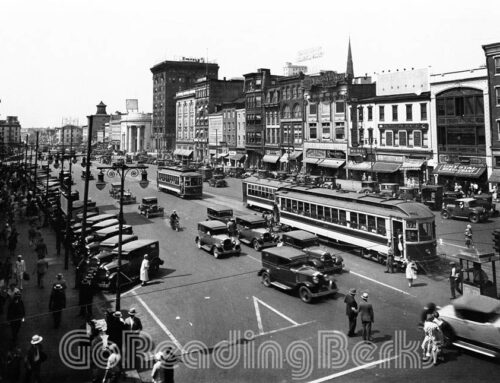
Reading’s rise was spectacular. By the early twentieth century, the city was a manufacturing powerhouse — iron, steel, textiles, hosiery, hardware, and the mighty Reading Railroad made it one of Pennsylvania’s most important industrial centers. Its population peaked at 111,171 in 1930, accounting for roughly half the county’s residents and an even larger share of its jobs. Penn Street, Reading’s grand commercial spine, was lined with department stores like Pomeroy’s and Whitner’s, theaters, restaurants, and the bustling energy of a self-contained urban economy.
But the very scale that made Reading great also made it vulnerable.
The Suburban Exodus Begins
The cracks appeared as early as 1940. A city property survey that year documented what officials called “an exodus of the population from the City to the suburbs.” Auto-owning families with stable incomes were relocating to new subdivisions in surrounding boroughs and townships like Wyomissing, Shillington, and Spring Township, leaving older inner neighborhoods with aging housing stock and lower-income residents.
By 1950, Reading was still hanging onto a population of about 110,000 — roughly half the county’s people and half its jobs. But by 1970, the city had hemorrhaged approximately 30,000 residents. The Community Renewal Program of 1969 laid bare the damage: three in ten housing units required replacement or major rehabilitation, with an estimated $100 million investment needed just to stabilize conditions. Blighted housing in inner-city neighborhoods had grown by more than 100% in just eight years.
Deindustrialization: The Knockout Blow
The loss of manufacturing devastated Reading. The Reading Railroad — once so iconic it graced the Monopoly board — collapsed in the post-war era. Textile mills shuttered. Heavy industry migrated south or overseas. As one longtime observer quoted in The Glass Jar City put it: “The 1960’s made this city into a different place. Losing the railroad hurt. Losing industry hurt. There was a rapid decay and we made too many mistakes.”
Pennsylvania had been the nation’s second-largest industrial workforce before 1929. By 1933, the state had already lost more than 270,000 manufacturing jobs. Reading, heavily dependent on a narrow industrial base, was hit disproportionately hard. The Community Renewal Program flatly stated that among the thirteen largest cities in Pennsylvania, “only Wilkes-Barre and Scranton, both of which have suffered extreme economic difficulties, have grown less than Reading since 1900.”
Urban Renewal: The Cure That Killed
Perhaps nothing damaged Reading more than the very programs designed to save it. Title I of the Housing Act of 1949 unleashed federal urban renewal funding that reshaped — and in many cases ravaged — American cities. Reading embraced urban renewal with an ambition that smaller communities simply couldn’t match.
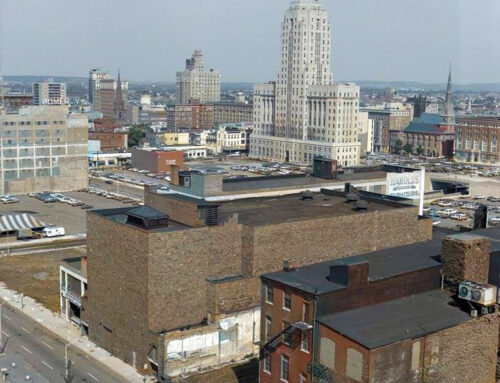
Between roughly 1965 and 1980, Reading demolished approximately 1,840 older structures citywide, including hundreds in designated urban renewal areas. Entire blocks of dense, historic development were razed and replaced with parking lots, highway ramps, public housing towers, and government buildings. The East Penn Mall project and a long-debated civic center consumed enormous political energy and public money while failing to reverse the city’s decline.
The Reading Eagle’s retrospective was blunt: “The same thing was happening in a lot of the older boroughs such as West Reading, Womelsdorf, Kutztown, etc., as their downtown mercantile districts faced the same stresses. Yet, for the most part, they did little or nothing, whereas Reading did anything but nothing.” The irony was savage — the smaller communities that lacked the resources to destroy their own downtowns were the ones that survived.
Corruption: The Invisible Tax
Reading’s descent was compounded by decades of organized crime and political corruption. As documented in the Westinghouse Broadcasting exposé The Corrupt City, crime syndicates controlled gambling, alcohol distribution, and prostitution through the active cooperation of compromised local officials. The corrupt years left the city “ill-equipped” to face the challenges that every American city confronted in the postwar era.
Martin Bookbinder, chairman of the Reading Redevelopment Authority, described finding “a total lack of public improvements. In the last 30 to 35 years, we’ve had a low tax base, which was fine — the people didn’t have to pay high taxes, but they received nothing for what they did pay. There have been no improvements in the water department. There hasn’t been a new playground built in 25 years.”
The Downward Spiral Accelerates
By the 2000s, the damage was compounding. The city’s property tax base had eroded so severely that in November 2009, the Commonwealth of Pennsylvania designated Reading as financially distressed under Act 47 — the municipal equivalent of hospice care. The Secretary of DCED warned that the city’s “pattern of operating deficits is unsustainable and if left unabated will force the city to significantly reduce or eliminate fundamental services.”
Then came the 2011 Census data: Reading was declared the poorest city in America. Sixty-seven percent of Berks County’s poor residents were concentrated within the city’s boundaries. A stark urban-suburban divide had calcified — the city majority-Latino and struggling, the surrounding county predominantly white and relatively affluent. As the GoReadingBerks Latino Heritage project documented, “County residents sometimes hold negative opinions of Reading, avoiding downtown altogether.”
Part II: The Borough That Stayed Small — and Stayed Alive
The Accidental Advantage of Smallness
West Reading’s survival was not inevitable. It was the product of structural advantages that the borough’s founders could never have foreseen.
Incorporated as a borough in 1907 after a second attempt (a 1903 effort was thwarted by popular opposition), West Reading adopted a council-manager form of government in 1926 — a progressive reform that brought professional administration to a community small enough to be managed effectively. The borough covered barely one square mile with a population that never exceeded a few thousand residents.
This smallness proved to be West Reading’s greatest asset. The borough was too small to attract the torrents of federal urban renewal money that devastated larger cities. It was too compact for the kind of sprawling public housing projects and highway-building schemes that tore apart Reading’s urban fabric. It was too intimate for corruption to take root on the industrial scale that poisoned Reading’s governance for decades.
Penn Avenue: Main Street, Not a Demolition Zone
The key physical difference was Penn Avenue itself. In Reading, Penn Street was a multi-story commercial canyon — grand department stores with offices above and apartments higher still. When suburban flight drained the customer base and upper-floor tenants departed, merchants were left trying to support massive multi-story buildings solely from ground-floor retail income. “Once the pigeons got in upstairs, deterioration was rapid,” the Reading Eagle observed.
West Reading’s Penn Avenue was different in kind. It was a classic small-town Main Street — one and two-story buildings, human-scale storefronts, walkable blocks. When the same suburban pressures hit in the 1950s and ’60s, the damage was real but not catastrophic. The buildings were smaller, the rents lower, the overhead manageable. A vacant storefront on a one-story building is a problem. A vacant five-story commercial structure with pigeons roosting in the upper floors is a disaster.
Institutional Anchors
West Reading also benefited enormously from institutional anchors that Reading’s downtown lacked. The Reading Hospital, the county’s second-largest employer, sits directly on Penn Avenue in West Reading. Its $354 million expansion completed in 2016 poured investment, foot traffic, and economic stability into the borough. The Reading Public Museum, with over 300,000 pieces of artwork and artifacts, the Neag Planetarium, and a 25-acre arboretum, draws visitors who shop and dine along Penn Avenue.
These institutions didn’t just provide jobs — they provided a reason to come to West Reading that had nothing to do with retail. When the shopping malls siphoned customers away from traditional downtowns across America, West Reading’s medical and cultural traffic kept Penn Avenue alive.
The Main Street Approach vs. the Wrecking Ball
The philosophical difference between Reading and West Reading’s approaches to decline could not have been starker.
Reading chose the wrecking ball. Flush with federal dollars, the city’s Redevelopment Authority razed block after block, believing that the old had to be destroyed to make way for the new. The result was surface parking lots where neighborhoods had stood, brutalist government buildings where Victorian streetscapes had charmed, and a downtown that lost its human scale, its architectural character, and its soul.
West Reading chose preservation and incremental improvement. The borough established a Main Street Program in 1997, modeled on the nationwide program that emphasizes four pillars: organization, design, economic development, and promotion. In 2005, it added the Elm Street Program focused on residential neighborhoods surrounding Penn Avenue. The Elm Street program became one of the best in Pennsylvania, winning state awards in 2016 and 2017.
In 2012, both programs were consolidated under the West Reading Community Revitalization Foundation, which coordinates grants, farmers markets, community events, and public art displays. The borough pursued zoning modifications creating new districts for the Penn Avenue corridor, revised design guidelines, increased parking flexibility, and encouraged façade improvements — all within the existing built environment.
This was the approach that preservation planners had been urging for Reading since at least 1980, when they argued that the city’s Victorian and early-twentieth-century fabric should be treated “as an asset to be maintained and reused rather than cleared.” Reading largely ignored that advice for decades. West Reading made it the cornerstone of its strategy.
Owner-Occupied Neighborhoods
West Reading’s residential neighborhoods remained predominantly owner-occupied — a crucial distinction. Reading’s inner-city housing stock, much of it aging row homes, increasingly fell into the hands of absentee landlords who extracted rent while investing nothing in maintenance. The 1969 Community Renewal Program documented the pattern in grim detail: low income, elderly populations, declining property values, and housing that was old when the New Deal was new.
West Reading’s comprehensive planning emphasized “strengthening residential neighborhoods with an emphasis on encouraging home-ownership, rehabilitating older buildings, and avoiding incompatible development.” When people own their homes, they maintain their sidewalks, plant gardens, attend borough council meetings, and vote for leaders who keep the streets clean. This civic feedback loop, so easily disrupted in a large city with transient populations and absentee ownership, remained intact in West Reading.
Governance at Human Scale
West Reading’s council-manager government, in place since 1926, provided professional, responsive administration without the political machines, patronage networks, and ward-boss corruption that plagued Reading for generations. In a borough of a few thousand people, government is personal. The borough manager is someone you see at the farmers market. Council members are your neighbors. Accountability is not abstract — it’s the person who doesn’t return your wave at the grocery store if the potholes don’t get fixed.
Reading, by contrast, struggled under the weight of a municipal government designed for a city of 110,000 but funded by a tax base that had been hollowed out by decades of flight. The city’s corrupt years left institutional scars that took generations to heal — and some would argue have never fully healed. As one commentator in The Glass Jar City lamented: “As far as I know, no city in Pennsylvania placed in Act 47 has ever recovered.”
Part III: The Structural Trap
Why Size Mattered Most
The deepest lesson of the Reading–West Reading divergence is about the structural trap of American urban policy. Federal programs — urban renewal, public housing, interstate highways — were designed for and directed at cities of a certain size. They came with strings, bureaucracies, and ideologies that often did more harm than good. Communities below a certain threshold of population and political significance were simply passed over.
West Reading was passed over. And that neglect was its salvation.
Reading received tens of millions of federal renewal dollars. It established a Redevelopment Authority with sweeping powers of eminent domain. It hired consultants, commissioned plans, and demolished neighborhoods. Every high-rise in the city, including the County Services Center, was built on renewal land. But as the Reading Eagle noted, “the commonly accepted wisdom that most of it was poured down the drain is not entirely misplaced.”
The boroughs that “did little or nothing” — West Reading, Kutztown, Womelsdorf — preserved their commercial districts by default. They didn’t have the money to tear them down. They didn’t have the political apparatus to condemn and clear. They simply maintained what they had, and when the pendulum swung back toward walkability, historic character, and human-scale communities, they were ready.
The Tax Base Death Spiral
Reading’s decline created a vicious cycle that West Reading largely avoided. As middle-class residents fled the city, the tax base shrank. As the tax base shrank, services deteriorated. As services deteriorated, more residents fled. Property values dropped, which attracted lower-income populations who needed more services, which required more revenue from a shrinking base.
West Reading, by contrast, maintained stable property values, a functional tax base, and a level of services that kept residents invested — literally and figuratively — in the community. The Reading Hospital alone generated economic activity that most small boroughs could only dream of.
The Demographic Divergence
Reading’s demographic transformation — from a predominantly white, working-class industrial city to a majority-Latino community — was driven by structural economic forces, not cultural ones. Affordable housing in a declining city attracted new residents from Puerto Rico and immigrants from the Dominican Republic and Mexico, many seeking better economic opportunities. But the welcome was not always warm. The resulting urban-suburban divide created an “us and them” environment that community leaders continue working to bridge.
West Reading experienced none of this demographic upheaval at the same scale. Its stable housing stock, higher property values, and maintained infrastructure created a self-selecting community that changed slowly, organically, and without the wrenching dislocations that defined Reading’s transformation.
Conclusion: Lessons From the Bridge
The story of Reading and West Reading is not unique. It has played out in Rust Belt cities across America — Youngstown and its suburbs, Buffalo and its ring communities, Camden and its neighboring townships. The pattern is grimly consistent: a central city hollowed out by deindustrialization, abandoned by the middle class, damaged by well-intentioned but destructive federal programs, and left to absorb the social costs of poverty while surrounding communities capture the tax base, the jobs, and the quality of life.
What makes West Reading’s story worth telling is the specificity of its survival. It wasn’t saved by a visionary leader or a single transformative investment. It was saved by a constellation of modest advantages:
- Smallness that kept it below the threshold of destructive federal attention
- Professional governance that prevented corruption from metastasizing
- Institutional anchors — the Hospital, the Museum — that sustained foot traffic independent of retail trends
- A Main Street philosophy that preserved and improved rather than demolished and rebuilt
- Owner-occupied neighborhoods that maintained civic investment
- Penn Avenue’s human scale — buildings small enough to survive vacancy, streets walkable enough to attract the next generation
Reading is not without hope. Its architectural fabric, though stressed, remains “remarkably complete,” as preservation advocates noted as early as 1980. Its Latino community brings entrepreneurial energy, cultural vibrancy, and demographic vitality. Recent downtown investments, including riverfront development and institutional commitments from Reading Area Community College and Alvernia University, suggest that the worst may be past.
But the lesson from across the Penn Avenue bridge endures: sometimes the greatest act of urban wisdom is restraint — preserving what you have, governing at a human scale, and resisting the seductive promise that tearing everything down will somehow build something better.
West Reading didn’t avoid blight because it did something extraordinary. It avoided blight because it didn’t do the extraordinary, destructive things that Reading did. And in that quiet refusal lies a lesson for every American community facing the siren call of radical reinvention.
Sources drawn from the GoReadingBerks archive, including: The Glass Jar City (Matthew Shaner), Shop Pomeroy’s First (Michael J. Lisicky), Reading Eagle 20th Century Journey 1970–1979, Community Renewal Program 1969, City of Reading Downtown 2020 Master Plan, Historic Preservation Reading Pennsylvania (1980), Reading Towne 1748–1998, The Corrupt City (Westinghouse Broadcasting), Lost Mount Penn, Slaying the Blight Dragon, The Latino Heritage of Reading and Berks County, and the Suburban Berks West Joint Comprehensive Plan (2018).




Leave A Comment