The Long Fight to Fix a Dangerous Crossing
The Belt Line Bridge over Lancaster Avenue
The Belt Line railroad bridge over Lancaster Avenue still stands today as a familiar part of southwest Reading. Motorists pass beneath it every day, often without realizing that the bridge was once at the center of a nearly decade-long fight involving motorists, trolley passengers, pedestrians, neighborhood residents, the Reading Company, City Council, Berks County, and state regulators.
By the 1930s, the crossing had become one of the most troublesome traffic bottlenecks in that part of Reading.
The bridge was part of the Reading Belt Line, constructed at the beginning of the 20th century to allow heavy freight traffic to bypass the increasingly congested center of the city. The approximately 7.4-mile double-track route became an important part of the Reading railroad system, carrying trains around Reading rather than forcing all through traffic along the older downtown route.
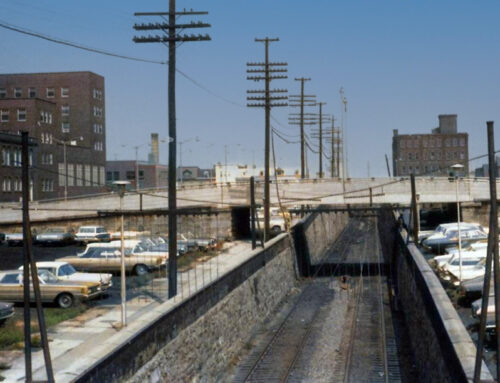
At Lancaster Avenue, those railroad tracks passed above an increasingly busy city street.
And that was where the trouble began.
Too Much Traffic for an Old Underpass
Lancaster Avenue had changed considerably since the Belt Line was first constructed.
Automobiles were becoming increasingly common, but they had to share the road beneath the bridge with streetcars. By the 1930s, two trolley tracks ran through the underpass, occupying much of the roadway.
Contemporary descriptions make clear just how tight the crossing had become. There was reportedly barely enough room for automobiles to pass on either side of the trolley tracks.
That alone made the underpass difficult for motorists. But pedestrians faced an even worse problem.
There were no adequate sidewalks beneath the bridge, forcing people to walk in the street alongside streetcars and automobiles. Schoolchildren and neighborhood residents traveling on foot had to negotiate the same narrow opening as moving vehicles.
The crossing had therefore become more than an inconvenience. It was regarded as a genuine traffic and pedestrian hazard.
The danger was serious enough that reports of the period referred to accidents at the location, and southwest Reading residents increasingly demanded that something be done.
Why the Reading Automobile Club Became Involved
The Reading Automobile Club was among the first organizations to push formally for changes. In 1930, the club began an effort to have the Lancaster Avenue Belt Line bridge widened and provided with sidewalks.
Its interest makes sense when the conditions beneath the bridge are considered.
Automobile traffic was increasing, yet the width available to motorists had not kept pace. Two trolley tracks occupied the middle of the underpass, leaving very little room for automobiles to pass. Drivers approaching the bridge were forced into a narrow shared corridor with streetcars, while pedestrians were walking in the roadway because there was no protected sidewalk.
Widening the bridge would allow Lancaster Avenue itself to be widened beneath it. Adding sidewalks would separate pedestrians from automobiles and trolleys.
So the Automobile Club was not simply asking for more convenient driving space. It was advocating for a redesign of a crossing that had become increasingly unsuited to the volume and mixture of traffic using it.
The proposal, however, quickly encountered another problem: Who was going to pay for it?
A Project Stalled by Money
Several different parties had an interest in the crossing.
The 1930 improvement effort stalled when the various parties argued that they could not bear their portions of the cost. The Reading Automobile Club's proposal was dropped. The dangerous conditions remained.
For several more years, automobiles continued squeezing beneath the bridge alongside streetcars, while pedestrians continued walking through the underpass without adequate sidewalks.
Southwest Reading Residents Take Up the Fight
By 1936, the issue had gained new momentum.
The Southwest Civic Association made improvement of the Belt Line bridge one of its major neighborhood concerns. Its president, Frances E. Beard, who lived at 1130 Lancaster Avenue, became closely associated with the campaign.
The association argued that the underpass had become a serious traffic problem. Its complaints were specific: two trolley tracks ran beneath the bridge, automobiles had barely enough room to pass, and pedestrians were forced to walk in the street. There was also concern about the number of accidents occurring in the area.
Instead of allowing the earlier proposal simply to disappear, the association began pressing Reading officials to revive the case.
In October 1936, City Council authorized Reading's attorneys to appear before the Public Service Commission and ask that proceedings concerning the Belt Line bridge over Lancaster Avenue be reopened.
The issue was now moving from neighborhood meetings to the state level.
Taking the Fight to Harrisburg
The Southwest Civic Association did not rely solely on City Hall.
In December 1936, association members prepared to travel directly to Harrisburg for a Public Service Commission hearing concerning the proposed widening of the Lancaster Avenue underpass.
Residents organized a motor caravan. Participants were instructed to assemble at the Kurtz House, near the bridge, before leaving for Harrisburg.
The association also circulated a petition demanding improvements. Approximately 500 signatures were collected.
Five hundred signatures showed that the bridge problem was not simply the complaint of a handful of residents.
The City of Reading was represented by City Solicitor Darlington Hoopes, while attorney Edgar S. Richardson represented the Reading Automobile Club. Frances Beard and other Southwest Civic Association officers were also deeply involved in the effort.
What had begun in 1930 as an Automobile Club proposal had become a broad civic campaign.
The Kurtz House: A Landmark Beside the Bridge

Old newspaper accounts frequently located the bridge by saying it was near the Kurtz House. At the time, that description would have immediately told Reading residents where the bridge was.
The Kurtz House stood at the junction of Lancaster Avenue and New Holland Road, at 800 Lancaster Avenue. Henry Kurtz erected the large three-story hotel in 1871, and it became one of the best-known establishments in the area.
The hotel served as much more than a place for travelers to stay. Country hotels were important gathering places, and the Kurtz House hosted meetings, meals, sporting events, and other community activities. A surviving advertisement from 1911, for example, promoted a "Big Tri-County Fox Chase" at the Kurtz House and invited hunt clubs and fox-hunting enthusiasts to attend.
By the 1930s, when the Belt Line bridge controversy was underway, the Kurtz House had already been a Lancaster Avenue landmark for more than 60 years. That explains why newspaper writers routinely described the railroad crossing simply as the Belt Line bridge "near the Kurtz House."
The hotel survived into the mid-20th century but was demolished in 1951, when a gas station was constructed on the site.
The bridge, however, remained.

What Lancaster Avenue Looked Like in 1938

A remarkable photograph from 1938 provides a clear view of the crossing during the period when these improvements were being pursued.
The photograph looks east along the 700 block of Lancaster Avenue. Above the roadway is the Reading Company Belt Line bridge. Below it are the two trolley tracks that had contributed to the congestion problem. The tracks continue directly beneath the railroad.
The photograph also shows automobiles traveling through the area, giving a good sense of how railroads, trolleys, cars, and pedestrians all had to coexist within a relatively confined space.
Between the trolley rails were granite paving blocks arranged in a distinctive circular pattern. Those blocks remained until 1952.
Suspended from the trolley wires was a sign carrying a simple instruction: SLOW. The warning was directed at trolley motormen approaching the underpass.
Farther east in the photograph rises the enormous Consumers' Gas Company gasholder at Fifth and Canal streets, another landmark that once dominated the industrial landscape of that part of Reading.
The scene looks dramatically different today, yet the railroad bridge provides a recognizable link between then and now.

Trolleys Added to the Congestion
Lancaster Avenue's trolley history helps explain why the crossing became so cramped.
Between 1891 and 1925, Lancaster Avenue had a single trolley track along the north side of the street. That changed during improvements to Reading's trolley network.
By 1925, double trolley tracks had been installed from Fourth and Chestnut streets, across the Bingaman Street Bridge, through the Belt Line underpass, and outward along Lancaster Avenue toward the city line at Baker Street.
That meant two sets of rails now occupied the roadway beneath a bridge originally constructed during an earlier era. As automobiles became more numerous during the 1920s and 1930s, all of these transportation systems were competing for the same limited space.
- The railroad was above.
- Two trolley tracks were below.
- Automobiles were trying to pass beside them.
- Pedestrians were trying to get through on foot.
Something eventually had to change.
The Long-Delayed Reconstruction Moves Forward
Years of civic pressure finally produced results.
By 1938, plans were moving forward for a new and wider crossing with improved pedestrian accommodations. The Southwest Civic Association was looking forward to the removal of what had become regarded as a dangerous location for schoolchildren and other pedestrians.
At one point, July 31 was mentioned as an anticipated completion date. Although the project and its final financial settlement extended beyond that timetable, the improvement that residents had demanded for years was finally becoming a reality.
A $65,000 Project
The reconstruction was a major public works project for the period. In May 1939, Reading City Council appropriated $30,000 toward the city's share of the new Belt Line bridge over Lancaster Avenue.
A later Public Utility Commission accounting placed the total cost of the bridge constructed by the Reading Company at $65,508.24, divided among several parties.
| City of Reading, assessed | $29,478.71 |
| still owed, August 1939 | $4,478.71 |
| Berks County, assessed | $16,377.06 |
| still owed, August 1939 | $2,377.08 |
| The Reading Company | $19,652.47 |
| Total cost of bridge | $65,508.24 |
Even after the structure had been completed, the financial paperwork continued.
Those numbers also help explain why the project had taken so long. Everyone agreed that the crossing needed improvement.
Agreeing on who should pay for it was much harder.
Frances Beard Cuts the Ribbon
The reconstructed bridge was formally dedicated on November 2, 1939. Frances Beard was given the honor of cutting the ribbon across Lancaster Avenue.
It was an appropriate recognition of the role she and the Southwest Civic Association had played. For years, neighborhood residents had attended meetings, circulated petitions, pressured City Council, traveled to Harrisburg, and repeatedly called attention to the hazards beneath the bridge.
Their campaign had helped transform an outdated and dangerous underpass into a safer crossing with more room for traffic and proper accommodations for pedestrians.
The Reading Automobile Club first pushes to widen the bridge and add sidewalks. The effort stalls over cost.
The Southwest Civic Association revives the issue. In October, City Council asks the Public Service Commission to reopen the case.
A motor caravan assembles at the Kurtz House and drives to Harrisburg with a petition of about 500 signatures.
Plans move forward for a new, wider crossing with pedestrian accommodations.
City Council appropriates $30,000 toward the city's share.
Frances Beard cuts the ribbon across Lancaster Avenue at the formal dedication.
The Bridge Still Stands
The Belt Line Bridge over Lancaster Avenue is not simply a relic of Reading's railroad era. It is still there. The world around it, however, has changed dramatically.
Gone
- The trolley tracks
- The Kurtz House 1951
- The granite paving blocks 1952
- The Consumers' Gas Company gasholder
Still here
- The Belt Line bridge above Lancaster Avenue
- Working railroad infrastructure, more than eight decades on
The automobile has long since replaced the trolley as the dominant form of street transportation. Yet the railroad bridge remains above Lancaster Avenue, and its history tells several stories at once.
It is part of the story of the Reading Railroad and the Belt Line that helped move freight around the city. It is part of Reading's trolley history. It is part of the development of Lancaster Avenue as automobile traffic increased. And perhaps most importantly, it is part of the history of neighborhood activism in southwest Reading.
The bridge that motorists pass beneath today exists in its improved form because generations ago people decided that the old arrangement was no longer safe enough. The Reading Automobile Club first pushed the issue. The Southwest Civic Association revived it. Hundreds of residents signed petitions. City officials became involved. The dispute went before state regulators. And after years of argument over safety, space, and money, the crossing was finally rebuilt.
More than eight decades later, the bridge still stands as a piece of working railroad infrastructure — and as a reminder that even something as ordinary as an underpass can have a surprisingly complicated history.




Leave A Comment