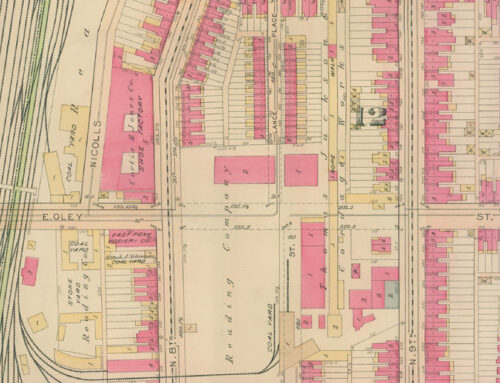
In a city defined by railroads and industry, the Washington Street Bridge in Reading was never just a simple crossing—it was a necessity. Spanning the busy Philadelphia & Reading Railroad Main Line, this bridge connected neighborhoods, carried daily traffic, and reflected the ongoing tension between city needs and railroad priorities.
From its earliest days, the bridge appears to have been constructed quickly to meet demand rather than longevity. One of the earliest known versions was a wooden structure, built in the style of a covered bridge, stretching across the tracks near what became known as the Seventh Street Cut. This design, while functional, would soon prove inadequate for a growing industrial city.
Early Demands for Improvement
By 1870, just a few decades into the railroad era, city officials were already pushing for improvements. The steep approaches to the bridge made travel difficult, and its narrow width limited both pedestrian and wagon traffic. City Council formally requested that the railroad lower the bridge to reduce the grade and widen it to accommodate increased use.
Yet, like many infrastructure debates in Reading’s history, progress stalled. The railroad showed little urgency, and financial disagreements quickly emerged. In 1874, plans surfaced for a more substantial replacement—an “open iron” bridge with a macadamized roadway, stone construction, wooden railings, and six-foot-wide pedestrian walkways on each side. The design even included stairways connecting directly to the Seventh Street sidewalks, an early attempt at pedestrian accessibility.
But the proposal came with a price: $12,000, of which the railroad expected the city to contribute $2,000. City Council refused. The result? Nothing changed.
A Bridge No One Wanted
What happened next says more about public sentiment than any official report ever could.
In July 1874, a fire broke out on the aging wooden bridge. The response from the surrounding neighborhood was anything but cooperative. According to a contemporary newspaper account, residents locked doors and blocked access to water sources, while children actively interfered with firefighting efforts—spilling buckets of water and even throwing combustible materials into the flames.
It was a scene almost surreal in its defiance. Instead of rallying to save the bridge, many locals appeared to hope for its destruction. The structure had become so deteriorated that some believed it unsafe even for a horse to cross. Rotten planks and brittle flooring only reinforced the perception that the bridge was beyond saving.
Whether the fire was accidental or intentional remains unknown—but the public’s reaction was clear: the old Washington Street Bridge had outlived its usefulness.
Replacement Without Resolution
Despite the fire and growing dissatisfaction, City Council still refused to fund a new bridge. The railroad ultimately replaced the damaged structure with another simple wooden bridge, spending approximately $4,000—a far more modest investment than the earlier iron proposal.
Over time, incremental improvements followed. The wooden superstructure was eventually replaced with cast iron through trusses, signaling a transition toward more durable materials as rail traffic and urban demands increased.
Still, these upgrades were reactive rather than visionary—piecemeal solutions to a problem that had lingered for decades.

View looking south at the Washington Street Bridge with the Court Street Bridge in the background from underneath the Walnut Street Bridge. (1958).

View from what is now the Berks County Service Center parking lot. This view shows the height difference between street level and the Walnut Street Bridge deck, with the eastern end of the bridge passing by nearby row homes (1959).

Banjo-style signals #90 and #88 were positioned along the Main Line near the Washington Street Bridge on the northern side of the Washington Street Bridge and on the western edge of the Seventh Street Cut. A printing company that produced the Reading High School yearbook for many years operated on the first floor of the C&L Clothing Factory showroom (1947).
The Modern Era: Concrete and Continuity
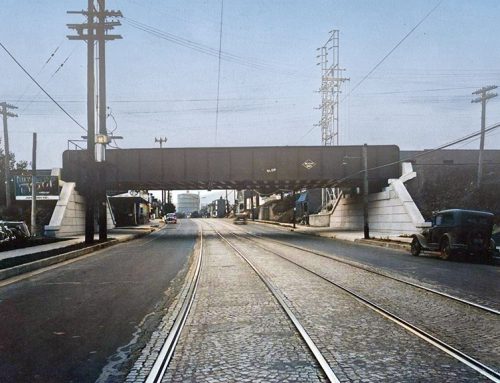
It wasn’t until 1964 that the Washington Street Bridge finally took on a form that could meet modern needs. The entire structure was replaced with a precast concrete slab bridge supported by encased I-beams—a design built for durability and sustained vehicular traffic.
Interestingly, maintenance responsibilities reflected the long-standing partnership—and friction—between the railroad and the city. The railroad continued to maintain the structure itself, while the city handled roadway paving.
By the late 1960s, photographs show a dramatically changed landscape. Nearby homes and buildings had begun to disappear, and the area surrounding the bridge was evolving along with Reading itself. Yet the bridge remained a constant—now capable of carrying hundreds of vehicles daily, a far cry from its fragile wooden beginnings.

View looking of Washington Street Bridge looking north (1969). Numerous homes and buildings have been demolished since this photograph was taken. At the time, residents and travelers had been using the newer concrete bridge for several years, enjoying a smoother and more accessible crossing.




Leave A Comment